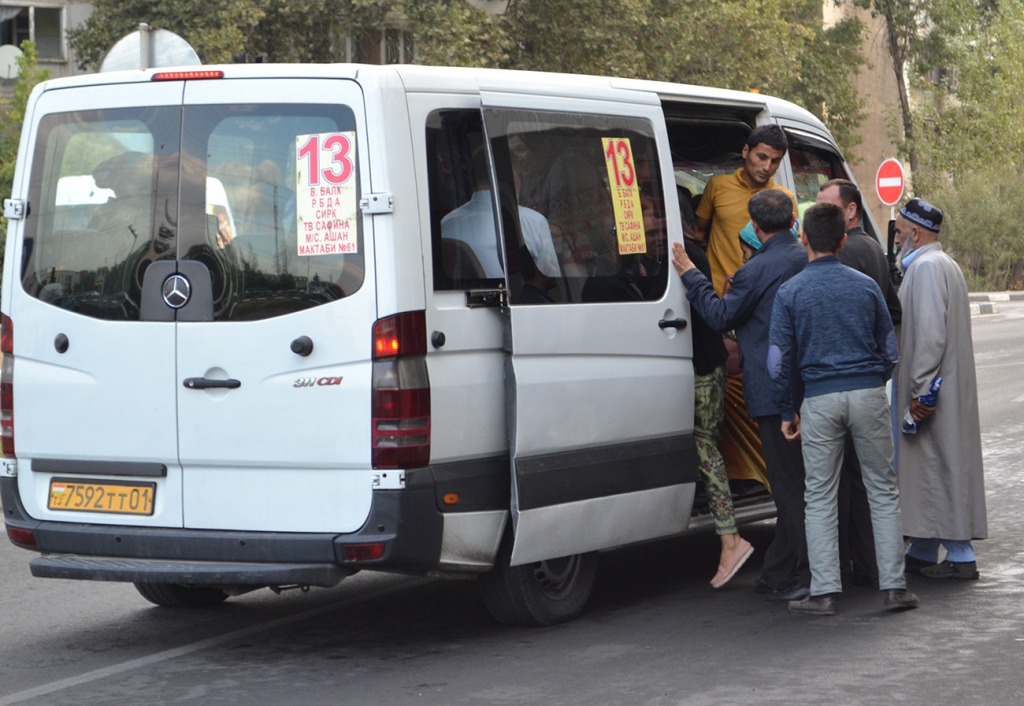
Since October 1, passengers in Dushanbe’s route minibuses have had the option to pay without cash, according to city authorities. Currently, 670 minibuses in the capital are equipped with devices (either POS terminals or validators) enabling cashless payment. Drivers are required to pay the CityCard company 30 somonis per day for servicing the equipment.
Firouz Ghafourzoda, head of the “Dushanbenaqliyotkhadamotrason” transport enterprise, told Asia-Plus that as of October 1 the majority of city minibuses have switched to the cashless system. He added that in 310 vehicles, only the stands (mounts) for the devices are installed so far — the actual validators will be fitted in the coming days.
“According to CityCard, by September 30 there were stands in 980 city minibuses, and validators already functioning in 670 of them. Our staff and CityCard employees are carrying out daily explanatory work with drivers about accepting payment without cash. More than 200 drivers have already organized their operations properly,” Ghafourzoda said.
He also noted that paying by card does not change the fare: it remains at 2 somonis 50 dirams.
“In minibuses, as in buses and trolleybuses, there is just one fare. With cashless payment, the price does not change — 2.50 somonis will still be deducted from the card,” he emphasized.
Ghafourzoda added that from October, drivers who have purchased and installed validators will pay CityCard 30 somonis daily for servicing:
“These funds cover service, internet, and resolving technical issues. The advantage is that previously drivers paid conductors up to 200 somonis. Passengers disliked the conductor model, there were conflicts and complaints. Now instead of 200 somonis, drivers pay only 30 somonis,” he said.
However, some drivers claim that the figure of 200 somonis is exaggerated, and that they paid conductors considerably less.
System effectiveness depends on riders too
Ghafourzoda stressed that passenger participation is crucial for the success of the cashless payment rollout in public transport. “Drivers still accept cash to avoid conflicts and complaints from passengers,” he said.
“We are educating drivers, but passengers’ attitude is very important. They must support the project and get cards. If a passenger doesn’t have a card, the driver is forced to accept cash to avoid misunderstandings and complaints,” Ghafourzoda added.
To ease issues with topping up city transport cards, the number of terminals under the CityCard project is to be increased. According to CityCard, over 560 Express Pay terminals currently operate in Dushanbe — 60 are used for issuing transport cards and more than 300 for topping up balances.
The company says it plans to add 35 more card‐issuance terminals and 40 more top-up terminals next month.
It is worth noting that CityCard began installing validators in Dushanbe minibuses several months ago. The devices were provided to drivers under a six‑month credit agreement, each costing 2,800 somonis. In response, some public transport drivers complained about the mandatory installation and the daily 30‑somoni payments to the company.
Previously, in the city’s buses and trolleybuses, passengers could pay either in cash or by transit card. Later, it was mandated that drivers issuing cash fares must provide a receipt — a rule that was not