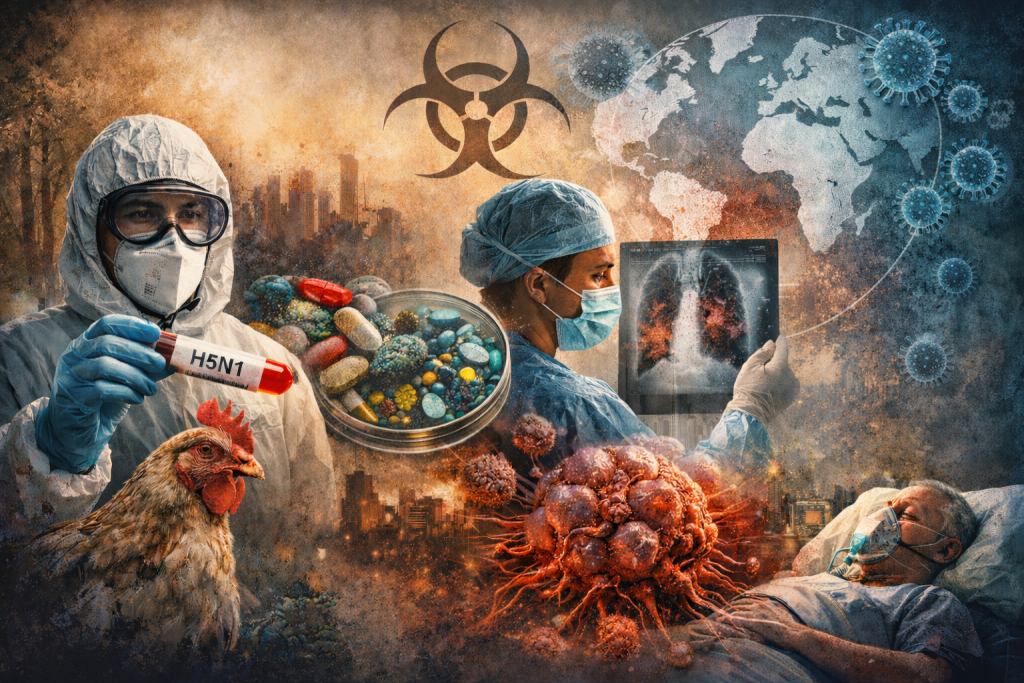
In 2026, experts and international organizations are highlighting a range of infectious and non-infectious threats that could seriously affect global health security. These include zoonotic viruses, antibiotic-resistant bacteria, and the rising burden of cancer.
Bird flu: a potentially deadly mutation
Influenza A viruses remain among the most serious global threats. Their ability to mutate rapidly and infect multiple animal species makes outbreaks difficult to predict. Scientists are particularly concerned about the highly pathogenic avian influenza virus H5N1.
According to the World Health Organization (WHO), the case fatality rate among confirmed infections may reach 50 percent or higher. However, experts stress that these figures reflect only reported cases. In many instances, infection may be mild and go undetected.
A study by Canadian researchers published in Epidemiology & Community Health suggests that the actual fatality rate of H5N1 is between 14 and 33 percent — still an alarmingly high level. Specialists also warn that several other viral diseases, including HIV, may regain prominence due to disruptions in funding for prevention and treatment programs.
Antibiotics losing their power
The growing resistance of bacteria to antibiotics is another major concern. According to a 2025 WHO report, one in six bacterial infections worldwide is already resistant to standard antibiotic treatment, with resistance rates increasing by 5–15 percent annually.
For the first time, global estimates have been published on resistance to 22 antibiotics used to treat urinary tract, gastrointestinal, bloodstream infections, and gonorrhea. The most alarming trends involve common pathogens such as Escherichia coli, Klebsiella pneumoniae, Acinetobacter, and Salmonella.
Experts warn that an increasing number of strains are becoming resistant even to last-line antibiotics. More than 40 percent of E. coli strains and 55 percent of Klebsiella strains are resistant to third-generation cephalosporins. Resistance to carbapenems — antibiotics reserved for severe infections — is also rising rapidly.
As a result, routine infections, including bladder infections, wound infections, and pneumonia, may become life-threatening.
Tuberculosis: an old threat persists
Tuberculosis remains one of the world’s deadliest infectious diseases. The WHO estimates that around 1.2 million people die from TB each year. Drug-resistant forms of the disease are most commonly reported in Central Asia, as well as in Russia, Ukraine, and Belarus.
Particular concern is caused by multidrug-resistant and extensively drug-resistant tuberculosis, which is far more difficult and time-consuming to treat.
Nipah virus — a candidate for “Disease X”
In 2018, the WHO introduced the term “Disease X” to describe an unknown pathogen that could cause a major epidemic or pandemic. One potential candidate is the Nipah virus.
Nipah can cause encephalitis and severe respiratory illness. According to the WHO, its fatality rate ranges from 40 to 75 percent. Most recorded cases have been linked to contact with bats — the virus’s natural reservoirs — as well as infected pigs.
Experts emphasize that Nipah has significant pandemic potential. As an RNA virus, it mutates rapidly, and the emergence of a strain capable of sustained human-to-human transmission cannot be ruled out. Increased human contact with wildlife, driven by deforestation, urbanization, and climate change, further heightens the risk.
Cancer cases on the rise
Scientists are also warning of a sharp increase in cancer cases worldwide. If current trends continue, the number of new cancer cases could exceed 30 million annually by 2050, with deaths approaching 19 million.
The fastest growth is expected in low- and middle-income countries, where health systems are less equipped for early diagnosis and treatment. About 40 percent of cancer deaths are linked to preventable risk factors, including smoking, unhealthy diets, obesity, and high blood sugar levels. Tobacco use alone accounts for one in five cancer deaths globally.
While cancer mortality is declining in high-income countries, it continues to rise in resource-limited regions, driven not only by lifestyle factors but also by demographic changes such as population aging.