Transparency International has published its Corruption Perception Index (CPI) for 2025. The results are disappointing, with Tajikistan ranking among the worst countries in terms of perceived corruption.
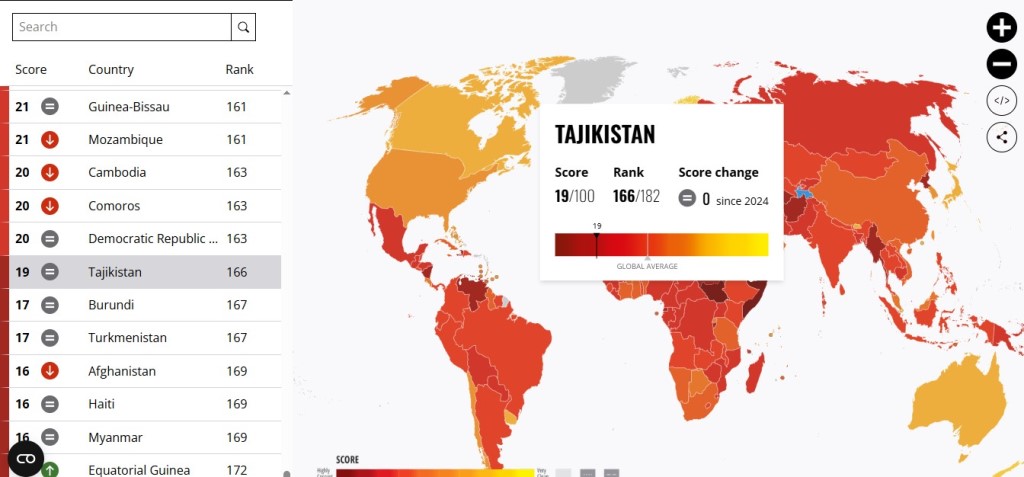
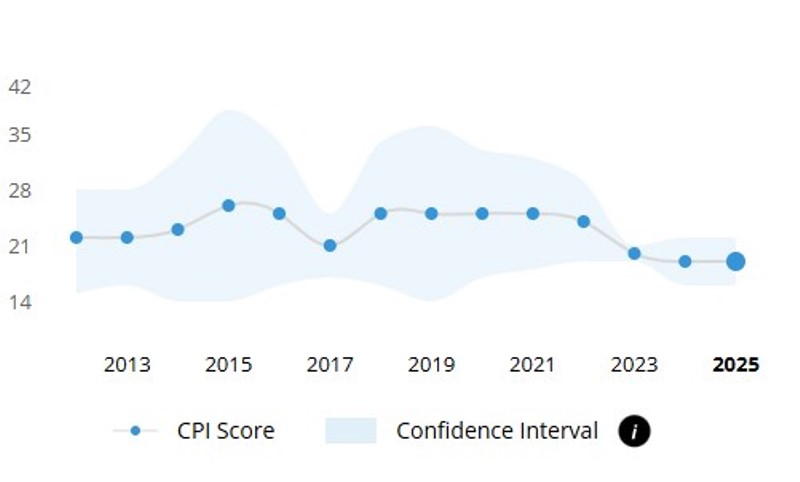
Tajikistan ranks 166th with 19 points
The CPI ranks 182 countries on a scale from 0 (very high corruption) to 100 (very low corruption). Tajikistan ranks 166th with a score of 19. For comparison, Kazakhstan ranks 96th with 38 points, Kyrgyzstan ranks 142nd with 26 points, and Uzbekistan is 124th with 31 points. Turkmenistan is ranked 167th with 17 points, and Afghanistan follows closely at 169th with 16 points.
Top performers
The top performers in the fight against corruption remain Denmark (89 points), Finland (88 points), and Singapore (84 points). However, the report highlights that despite these countries leading the index, there has been no significant progress in the fight against corruption compared to previous years.
Challenges in Eastern Europe and Central Asia
The report includes a separate section on Eastern Europe and Central Asia, where the region scored only 34 out of 100 points. Six of the 19 countries in the region significantly worsened their scores, and only seven showed improvements, indicating stagnation in reforms and the weakening of institutions that contribute to corruption.
The criticism also extends to Tajikistan, which faces issues common to countries with authoritarian regimes. In Central Asia, including Kyrgyzstan and Kazakhstan, repression and restrictions on civil society continue to grow.
Corruption destroys the hopes and dreams of youth
The report stresses that corruption leads to underfunded essential public services such as healthcare and infrastructure, undermining the hopes and dreams of youth. The global average CPI score has dropped to a new low of 42, with more than two-thirds of countries scoring below 50.
Call for action
Transparency International’s Executive Director, Maya Martyni, stated that to improve the situation, it is essential to strengthen judicial systems, increase oversight of public spending, and prevent the flow of corrupt money into the electoral process. "Responsible leaders and independent institutions are needed to protect public interests, especially in the face of global challenges such as the climate crisis and instability," she added.