
The authorities of Tajikistan are introducing an environmental fee for the import of mineral fuels—oil, gas, and coal. How might this affect the final cost of fuel, and what consequences could ordinary consumers face?
Members of the Majlisi Namoyandagon (Tajikistan’s lower house of parliament) have adopted amendments to the law “On Other Mandatory Payments to the Budget,” according to which an environmental fee will be charged when importing mineral (fossil) fuels into the country.
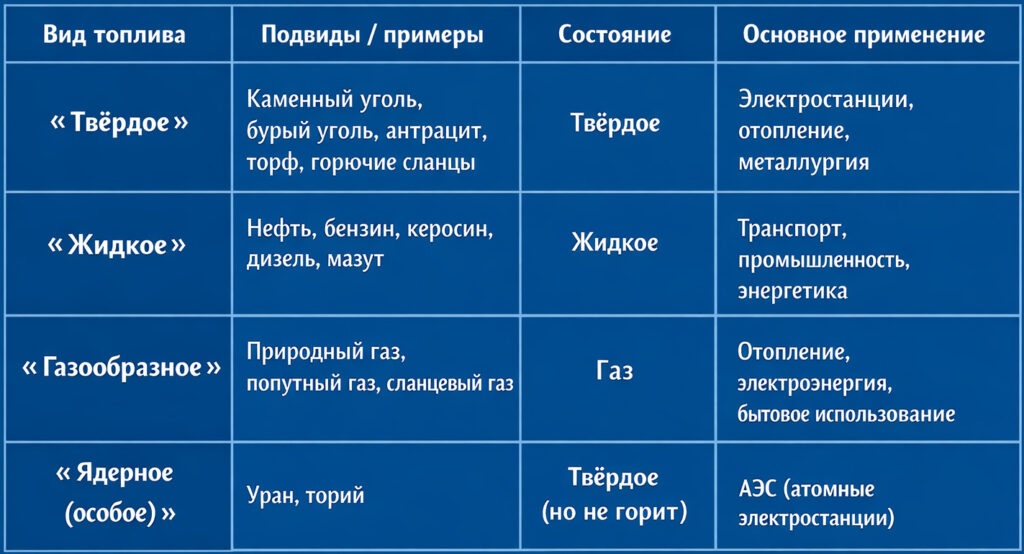
Mineral fuel includes oil and its products, natural gas, coal, and some other natural combustible substances that are extracted from the earth.
Sadoi Mardum, a mouthpiece of Tajik parliament, reports that presenting the bill to lawmakers, the country’s Minister of Finance, Faiziddin Qahhorzoda, noted that to simplify the process of collecting these payments, it is proposed to charge them directly from importers of goods and materials when importing fuel into the territory of Tajikistan.
In other words, these payments are considered external taxes, which are collected by the Customs Service under the Government of Tajikistan.
“The main goal of preparing this law project is to improve the system of environmental payments, including taxes on the import of mineral fuels, oil, nd their processed products,” the minister added.
It should be noted that the adoption of the amendment by the lower house must be seconded by the upper house (Majlisi Milli) and sent for signature (approval) to the president.
Meanwhile, government’s decree “On the Approval of Fees for Carrying Out Legally Significant Actions and Fees for the Issuance of Permits for the Use of Natural and Other Available Resources” was previously published on the legal information portal of the Ministry of Justice. According to this document, the environmental fee for “mineral fuel, oil and oil processing products, bituminous substances, and mineral waxes” is set at 30 euros (331 somoni at the official NBT exchange rate on 27.04.2026) per ton, regardless of the type of fuel.
The document clarifies that the environmental fee is charged once upon import without subsequent collection of funds for fuel use.
An environmental fee is money that companies or individuals pay for using natural resources or polluting the environment. This money is usually used for the restoration of nature and environmental protection.
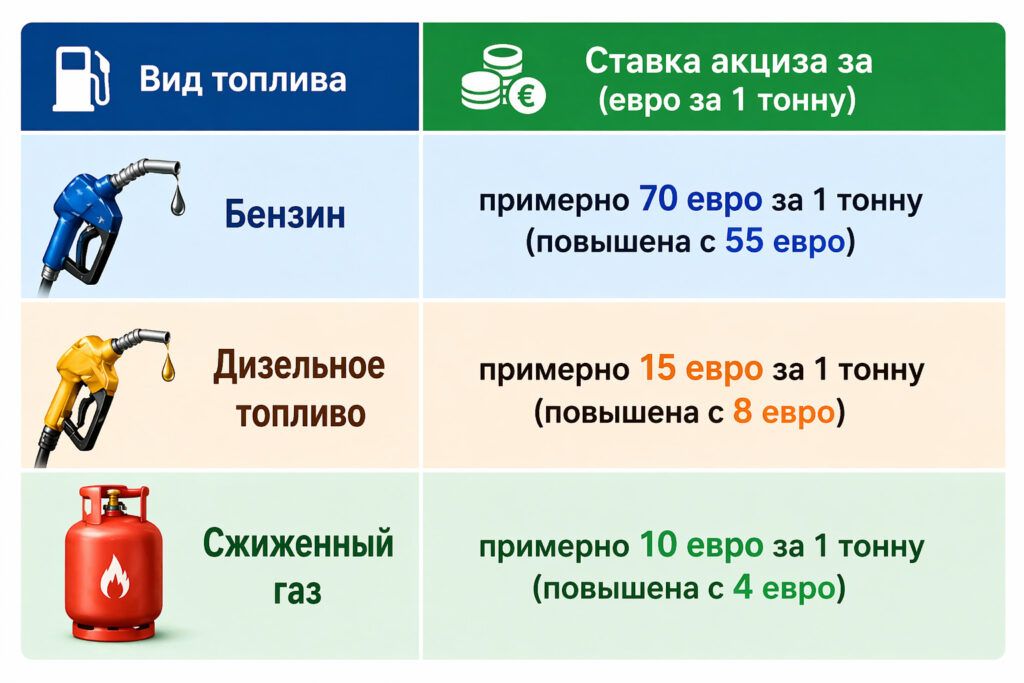
It should be noted that fuel importers pay an excise tax at the border, in addition to customs duties and VAT. This type of tax is levied on producers, suppliers, and sellers of goods and products that have a harmful impact on human health and the environment, such as alcohol, tobacco, oil, and others. Excise rates on combustible materials were increased in May of last year and are currently as follows:
The consumer will ultimately pay
Tajikistan is almost entirely dependent on the import of mineral fuels to meet its own needs, except for domestic coal production and minor volumes of natural gas and oil.
According to the Ministry of Energy, in 2025, the republic imported about 1.7 million tons of fuel and lubricants.
This volume would have brought the republic’s budget over half a billion somoni if the environmental fee at a rate of 30 euros had been in effect. This amount equals approximately 1% of the country’s budget revenues last year—a small but noticeable addition.
Fuel importers say that any extra costs will be passed on to end consumers, as their profits are already small—supposedly no more than 10%.
However, the authorities have indirectly confirmed that they understand: ultimately, end consumers will have to pay more.
The finance minister, when discussing the amendments in the lower house, noted that initially, the environmental tax on fuel was planned to be charged from each vehicle, regardless of its brand, engine power, and emissions. However, later, according to him, “taking into account the experience of neighboring countries and development partners,” it was decided to introduce environmental fees on the import of mineral fuels, oil, their processed products, as well as bitumen and mineral waxes.
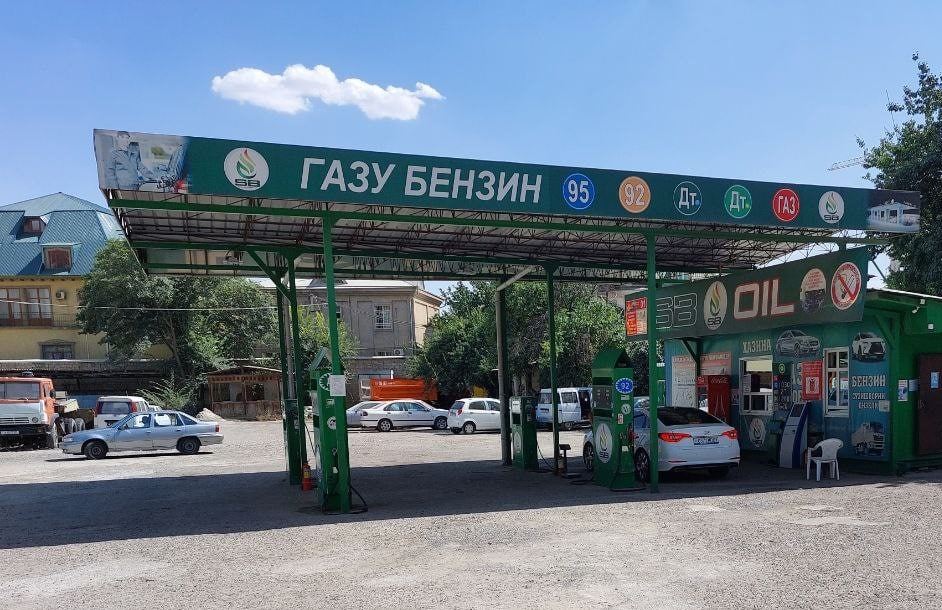
How much could fuel prices rise?
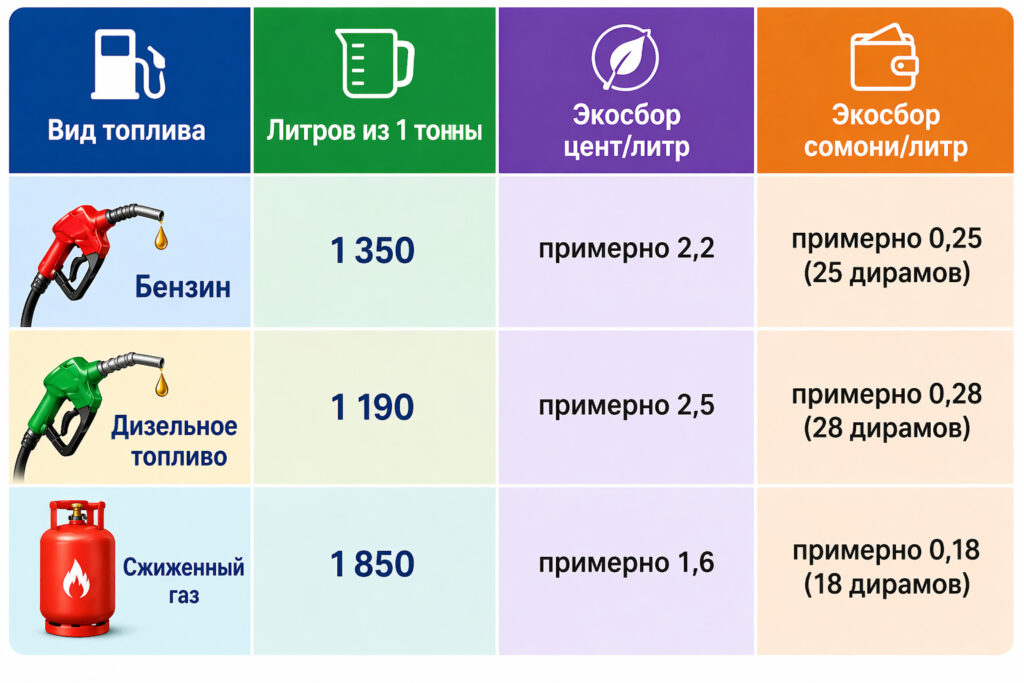
To understand how the environmental fee will affect the price of major types of fuel, first, we need to determine how many liters are obtained from one ton.
One ton of gasoline contains 1350 liters, diesel fuel—1190 liters, and liquefied gas—1850 liters.
Accordingly, if we distribute the environmental fee of 30 euros (3000 cents) per ton across each liter, we get the following results:
– gasoline — 2.2 cents (25 dirams at the NBT exchange rate on 20.04.2026) per liter;
– diesel fuel — 2.5 cents (28 dirams);
– liquefied gas — 1.6 cents (18 dirams).
Thus, the environmental fee will increase the price of all types of fuel, but not equally: diesel will become the most expensive, while liquefied gas will increase the least.
Global experience
To date, there are practically no environmental fees in global practice that are specifically charged upon the import of mineral fuels—oil, gas, or coal.
Even in countries with advanced climate policies, other mechanisms are used.
For example, the European Union is implementing a carbon border adjustment mechanism, but it does not apply to fuel—it only includes specific categories of products such as metallurgy, cement, and fertilizers.
In the United States, there is no federal environmental fee on the import of oil and gas. Canada has a carbon tax, but it is applied at the consumption stage. In the United Kingdom, similar mechanisms are being considered, but fuel is also not included.
In Asian countries—China, Japan, and South Korea—emission control systems are in place, but they also do not provide for environmental taxation on fuel imports.
In general, fuel taxes and excises are widely applied globally, but they apply to both imported and domestic fuel and are not tied specifically to the import stage.
The absence of such mechanisms is explained by several reasons:
– countries’ dependence on energy imports;
– the risk of rising energy prices;
– possible social consequences;
– difficulties in assessing the carbon footprint of fuel.
Thus, the approach proposed in Tajikistan can be considered atypical.
Is it worth rushing to introduce the fee?
Some experts believe that it is better not to rush with the introduction of the environmental fee.
According to them, the situation in the oil market is already unstable, and additional fees may only increase pressure on the economy.
“During such periods, countries usually do not rush to introduce new fees. They either postpone them or launch them gradually—when the situation becomes calmer,” says an analyst who wished to remain anonymous.
However, this does not mean a complete rejection of the environmental fee. Rather, it is about choosing a more appropriate time and observing how such measures will work in other countries.
The interlocutor reminds us that current prices are influenced not only by domestic policy but also by the global situation. Due to tensions in the Middle East, oil prices are already rising, and there is a risk that prices will continue to increase.
“If a new fee is added at this moment, the final increase in fuel prices could be significantly higher,” he noted.
The specialist also emphasized that even a small increase in fuel prices is felt more broadly than it seems. Because fuel affects almost everything—from transportation costs to food prices.
A separate issue is who will ultimately pay. Here experts agree: the main burden will fall on consumers.
“Importers cannot keep prices at their expense for long—they already have small profits. Therefore, any new costs usually get passed on to the price at the pumps,” say market representatives.
At the same time, specialists note that the environmental fee itself is not necessarily a bad idea. It can be beneficial if the collected money is indeed used for environmental protection. However, the key point is when to introduce it.
Experts believe it is better to do this when oil prices are stable or decreasing. Then it will be less painful for people and businesses.