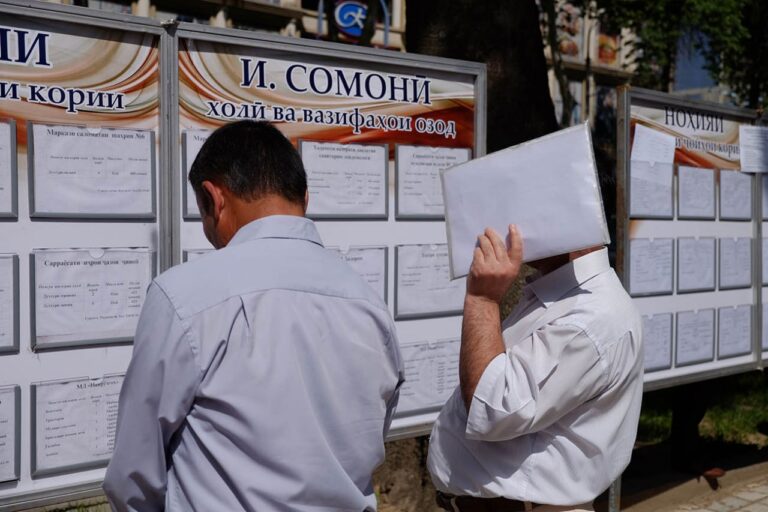
DUSHANBE, December 18, Asia-Plus – December 18 is the International Migrants Day.
This day was proclaimed on 4 December, 2000 by the UN General Assembly because of the rising number of migrants all over the world. On December 18, 1990 the Assembly signed the International Convention on the Protection of the Rights of All Migrant Workers and Members of Their Families. It is suggested to state parties, intergovernmental and nongovernmental organizations to mark the International Migrants Day especially with information distribution activities about human rights and basic freedoms of the migrants, experience exchange and measures for the development of the protection of migrants.
Labour migration can increase the risk of an HIV/AIDS epidemic development in Tajikistan, because most of the migrants are seasonal workers and shuttle traders, who travel between origin and host countries, where STIs and HIV incidences are high. HIV/AIDS is a disease of the social category, and the prevalence and effectiveness of combating it depends on socio-economical and life conditions, social behavior and state policy.
On December 15, 2006 International Organization for Migration (IOM) Mission in Tajikistan with the financial support of the Global Fund to Fight AIDS, Tuberculosis and Malaria (Global Fund) conducted a national conference formally titled “Labour migration. HIV/AIDS and Human Rights” in Dushnabe.
The main goals of the conference were to inform conference participants about STIs/HIV/AIDS prevention activities among labour migrants and their families within the framework of the grant of the Global Fund, discuss the legal aspects of labour migration and the impact of the legal status to labour migrants’ vulnerability related to STIs/HIV/AIDS, identify immediate measures in the fight against the HIV epidemic among labour migrants and their families, including effective legislation mechanisms and the development on labour migration regulation on the national level and in the host countries.
The conference resulted in adoption of a resolution that draws the attention of the parliamentarians, heads of the interested departments and structures to the HIV/AIDS problem
among labour migrants and their families. The resolution will also give recommendations on improvements of the existing legislation measures on labour migration regulation and combating
the HIV epidemic among labour migrants and their families.
UNPD HIV/AIDS and Malaria Advisor, Dr. Saleban Omar, said in an interview with Asia-Plus that HIV/AIDS has shown an upward tendency in Tajikistan. “Before the end of the last year, we did not have data about the HIV/AIDS situation among migrants,” said Omar, “We just knew about several cases that thad been revealed accidently.”
This year, the Republican AIDS-Prevention Center jointly with the Scientific-Research Center Sharq and the IOM Mission in Tajikistan carried out a survey under financial support of the Global Fund and the results were “distressing,” according to him. “The results demonstrate that the dicease has shown an upward tendency in the republic,” Omar said, noting that 600,000 people who annually leave the country seeking better employment opportunities should be considered in the at-rick group.
Azamjon Mirzoyev, director of the Republican AIDS-Prevention Center, said that 2.2 percent of 400 surveyed across the region had been estiamted as HIV-infected. “The survey results show that the rate of HIV infection among labor migrants is increasing,” Mizroyev stressed.
According to him, 16 families have been registered in the country, where women contracted the disease from their husbands, who were labor migrants.
Dwelling on statistics, Mirzoyev said that over the past two years alone, more than 200 new cases of HIV infection have been registered in Tajikistan.