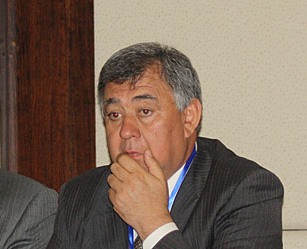
DUSHANBE, October 19, 2011, Asia-Plus — Tajikistan fully supports international community’s efforts to develop water cooperation, Tajik Deputy Prime Minister Murodali Alimardon announced at the prepcom conference “Towards the UN Conference on Sustainable Development (RIO +20): Water Cooperation Issues” in Dushanbe on October 19.
“In recent decades, in connection with development of economy and population growth the water problems having been experienced more and more acutely and impacts of climate change on water resources have deteriorated this problem,” Alimardon noted.
According to him, Tajikistan has offered a number of initiatives to tackle this problem and they have been supported by the majority of countries of the world. Thus, in accordance with the United Nations General Assembly resolution the year of 2013 is declared as the International Year of Water Cooperation, Alimardon noted.
Tajik official stressed that strengthening of dialogue and mutual understanding as well as development of partnership and cooperation played an important role in tackling the water problems in the region.
“Meanwhile, lack of proper cooperation involves serious risks and costs,” noted Alimardon. “Because of improper cooperation many problems remain unsettled. Finally, all this negatively impacts the economic and social situation in all the countries sharing the common basin.”
Tajik deputy prime minister considers that expansion of water cooperation could make contribution to development of a green economy.
According to the United Nations Environment Programme (UNEP) (2010), a green economy is one that results in improved human well-being and social equity, while significantly reducing environmental risks and ecological scarcities. A green economy is an economy or economic development model based on sustainable development and a knowledge of ecological economics.
“It especially concerns water cooperation in the trans-boundary context, when some countries have oil and natural gas, while others are lacking substantial energy resources but have huge water resources,” said Alimardon, “In Central Asia, for example, Kazakhstan, Turkmenistan, and Uzbekistan have oil and natural gas but little water; Kyrgyzstan and Tajikistan, on the other hand, are lacking substantial energy resources but have considerable water resources. Therefore, the main source for power generation in the upstream countries is hydropower, while in the downstream countries, hydrocarbons are the main resource for power generation.”
He noted that the Central Asian region had a huge hydropower potential. Tajikistan alone has reserves of water and power resources in the amount of 527 billion kWh. At present the country is using only 3 or 4 percent of these reserves. “Further development of these reserves would allow not only reducing carbon emissions but also considerably saving Central Asia’s oil, gas and coal reserves,” Alimardon noted.
He added that expansion of the trans-boundary water cooperation would lay a good foundation for efficient use of renewable energy sources, “which is one of components of the green economy.”
Organized by the Government of Tajikistan and the UN Department of Economic and Social Affairs (DESA) in cooperation with UN-Water, UNDP Office in Dushanbe and the South-South News, the Dushanbe conference is discussing current issues and challenges in water cooperation that will be later included in the concept note and the program of the thematic session on water cooperation in the framework of the Conference Rio+20. The outcome of the Dushanbe conference, as well as the application on behalf of the Government of Tajikistan will be submitted to the Secretariat of the Conference Rio+20 before November 1, 2011.