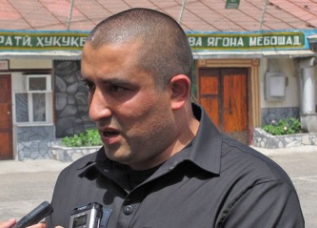
DUSHANBE, December 6, 2011, Asia-Plus — Human rights activist and lawyer Oynihol Bobonazarova has visited Sadriddin Toshev in prison and persuaded him to end a huger strike.
“The meeting with the prison inmate took place due to Major-General Izatullo Sharipov, the chief of the Main Penal Directorate within the Ministry of Justice,” she told Asia-Plus Tuesday afternoon.
“I wanted to meet with Toshev in order to know in what health condition he is now,” said Ms. Bobonazarova. “I persuaded him to end the hunger strike. I asked him, “If anybody from international organizations or public institutions has come to see him?” He said that nobody and I persuaded him to end the hunger strike. I said that media outlets have written about him and he does not have to go on hunger strike any more in order to be heard.”
Prison inmate Sadriddin Toshev, who is also known as “Qori Sadriddin,” went on hunger strike on November 28 to demand amnesty.
He was sentenced to 25 years in prison more than ten years ago. The sentence followed his conviction on the charges of banditry, forcible seizure of power and terrorism.
On November 28, Asia-Plus received an open letter by Sadriddin Toshev to President Emomali Rahmon, Prosecutor-General Sherkhon Salimzoda, Minister of Justice Bakhtiyor Khudoyorov, both parliament speakers, Office of the UN High Commissioners for Human Rights and other international human rights organizations and media.
In his letter, Toshev complains that no one of amnesties granted over the past ten years has benefited him.
Toshev at one time reportedly was supporter of the former United Tajik Opposition (UTO) and he then allegedly joined the mutiny Colonel Mahmoud Khudoiberdiyev.
Toshev noted in his letter that in a report released at a news conference in Dushanbe, Prosecutor-General Sherkhon Salimzoda named him on September 1 along with other former militants whose jail terms had been reduced.
“Under the amnesty law of August 28, 2011, my term should have been cut and under Article 10 of the amnesty law of August 20, 2011, I should have been released, however, that has not happened so far,” the letter says. He also notes that he goes on a hunger strike beginning on November 28 to protect his rights and to protest injustice.
It is to be noted that Prosecutor-General Sherkhon Salimzoda announced at a news conference in Dushanbe on September 1 that 32 militants who fought government troops in 1997 in Khatlon province, Dushanbe, Hisor, Shahrinav and Tursunzoda as well as armed clash of 1998 in Sughd province were among prisoners freed under the amnesty. Tajik chief prosecutor also added that Yoribek Ibrohimov (Sheikh Yoribek), Ismatullo Habibulloyev (Ismati Auli), Yoqub Salimov, Sadriddin Toshev, Mahmadruzi Iskandarov and Jamshed Siyayev (bead-selling business) have their prison terms cut by two years under the 2011 amnesty.
We will recall that the 2011 amnesty mainly benefited men over 55, those prisoners suffering from cancer or tuberculosis, and women. The amnesty also applied to members of political parties, public associations and illegal religious organizations who were sentenced to five years in prison as well as persons who were sentenced to more than five years in prison and have served three-quarters of their terms.
The amnesty also benefited militants who fought government troops in 1997 in Khatlon province, Dushanbe, Hisor, Shahrinav and Tursunzoda as well as armed clash of 1998 in Sughd province if they have served half their sentences.
The amnesty excluded those serving sentences for serious crimes such as terrorism and extremism, killing two and more people, recidivists or those who committed crimes in prison. This is the 13th amnesty the government has approved.