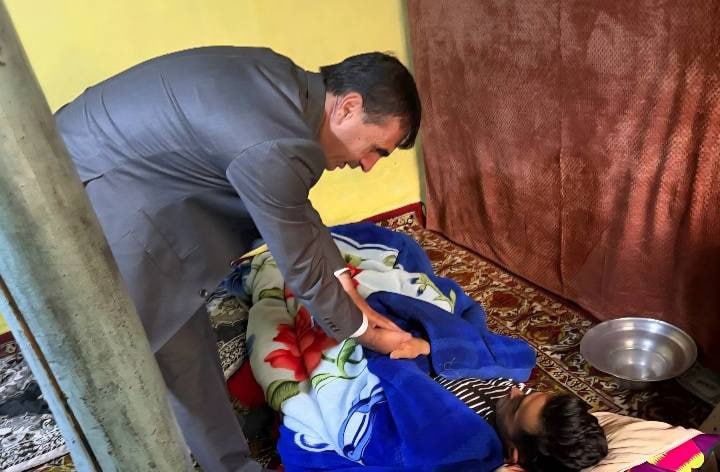
KHUJAND, July 17, 2013, Asia-Plus — One of anthrax patients recently registered in the northern province of Sughd has died.
One of physicians with the Khujand infectious diseases hospital, who wanted to remain unnamed, says that one of anthrax patients taken to their hospital from the Ayni district has died.
“The 57-year-old resident of Ayni probably contracted the disease while slaughtering an infected cow,” said the physician. “He was taken to the rural hospital on July 5 and they took him to our hospital only on July 7. Unfortunately, it was too late and he died on July 8.”
We will recall that cases of anthrax were reported in two districts of Sughd – Ayni and Panjakent. According to the first deputy head of the Sughd sanitary and epidemiological center, Nasibjon Ikromov, four cases of anthrax were registered in Ayni and two cases were registered in Panjakent. “The anthrax patients from Ayni have been taken to the hospital in Khujand for further medical treatment,” Ikromov added.
Specialists from the Sughd sanitary and epidemiological center say no other cases of anthrax have been registered in the province.
Anthrax is an acute disease caused by the bacterium Bacillus anthracis. Most forms of the disease are lethal, and it affects both humans and animals. There are effective vaccines against anthrax, and some forms of the disease respond well to antibiotic treatment.
Like many other members of the genus Bacillus, Bacillus anthracis can form dormant endospores (often referred to as “spores” for short, but not to be confused with fungal spores) that are able to survive in harsh conditions for decades or even centuries. Such spores can be found on all continents, even Antarctica. When spores are inhaled, ingested, or come into contact with a skin lesion on a host, they may become reactivated and multiply rapidly.
Anthrax commonly infects wild and domesticated herbivorous mammals that ingest or inhale the spores while grazing. Ingestion is thought to be the most common route by which herbivores contract anthrax. Carnivores living in the same environment may become infected by consuming infected animals. Diseased animals can spread anthrax to humans, either by direct contact (e.g., inoculation of infected blood to broken skin) or by consumption of a diseased animal”s flesh.