Tajik air navigation company establishes MLAT system to accurately locate aircraft
DUSHANBE, August 12, 2013, Asia-Plus — Tajik air navigation company, Tajikaeronavigatsiya, is reportedly completing establishment of the multilateration (MLAT) system in the central and southern parts of Tajikistan.
An official source at Tajikaeronavigatsiya says the MLAT system has been successfully used in the northern part of the country since 2010.
“The Czech company, Era, is establishing the MLAT system in Tajikistan,” the source noted.
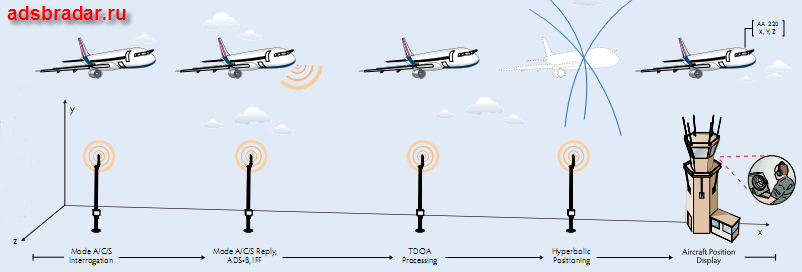
Multilateration is a navigation technique based on the measurement of the difference in distance to two or more stations at known locations that broadcast signals at known times. Unlike measurements of absolute distance or angle, measuring the difference in distance results in an infinite number of locations that satisfy the measurement. When these possible locations are plotted, they form a hyperbolic curve. To locate the exact location along that curve, a second measurement is taken to a different pair of stations to produce a second curve, which intersects with the first. When the two are compared, a small number of possible locations are revealed, producing a “fix.”
Multilateration is a common technique in radio navigation systems, where it is known as hyperbolic navigation. These systems are relatively easy to construct as there is no need for a common clock, and the difference in the signal timing can be measured visibly using an oscilloscope.
Multilateration is commonly used in civil and military surveillance applications to accurately locate an aircraft, vehicle or stationary emitter by measuring the “Time Difference of Arrival” (TDOA). MLAT is a surveillance application that accurately establishes the position of transmissions, matches any identity data (octal code, aircraft address or flight identification) that is part of the transmission and sends it to the ATM (Air Traffic Management) system. MLAT is considered to be a cooperative surveillance technique, combining a dependence on target-derived data for identification and altitude with ground based calculation of position.