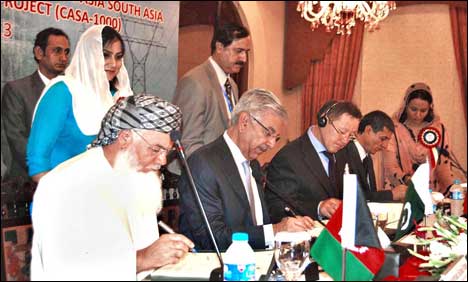
DUSHANBE, September 17, 2013, Asia-Plus — Representatives from Tajikistan, Kyrgyzstan, Afghanistan, and Pakistan have gathered in Islamabad, Pakistan for a ministerial meeting to discuss financing and environmental and social assessments related to the Central Asia South Asia Electricity Trade and Transmission Project (CASA 1000).
According to the Tajik Embassy in Islamabad, they signed an inter-governmental council (IGC) resolution.
Tajik delegation participating at the meeting was led by Poulod Muhiddinov, Deputy Minister of Energy and Industry.
The sides reportedly agreed that Tajikistan and Kyrgyzstan will supply surplus power to Afghanistan and Pakistan during summer period (from May to September). During 15 years, Afghanistan will receive some 300 megawatts of electricity annually and Pakistan some 1,000 megawatts.
The Express Tribune
(Pakistan) reported today that Afghanistan, Kyrgyzstan, Tajikistan and Pakistan signaled their commitment to the landmark project by signing the IGC resolution at the ministerial level.
According to
The Express Tribune
, an investment of $1 billion will be made to create conditions for sustainable hydropower trade to ease shortages in importing countries while enhancing sector and budget revenues in exporting countries.
Pakistani Water and Power Minister Khawaja Muhammad Asif was quoted as saying, “We sincerely hope that realization of CASA-1000 will take us a long way in developing further the relationship between Central Asian and South Asian countries.”
Pakistan officials noted that CASA-1000 could ease electricity shortages in peak summer season when consumer demand reached the highest mark and reduce the country”s reliance on costly, carbon-intensive oil-based generation.
Afghan officials highlighted how important the project was in establishing the country”s role as a viable transit nation and enhancing its growth prospects at a critical time,
The Express Tribune
noted.
Representatives of Tajikistan and Kyrgyzstan reportedly welcomed the project, believing it would serve as a potential source of generating fiscal and power sector revenues that could be used to address their acute energy shortages in winter.
Through the IGC, the four countries are working together to arrive at decisions on project implementation and operation, policies and rules, and technical, safety and environmental standards,
The Express Tribune
said.
Preparations for the project were reportedly discussed during the two-day deliberations, with progress made on plans to negotiate commercial agreements, environment and social safeguard documents and host public consultations later this year.
The meeting participants agreed that an implementation plan for community benefit-sharing during construction and operation would need to be developed in coming months.
Legal consultants presented an update on the preparation of important agreements, including the master agreement, power purchase agreements and coordination agreement,
The Express Tribune
said.
Other preparatory activities pertaining to financing, selecting a developer and operator, finalizing environmental and social assessment and a benefit-sharing plan for communities living around the corridor of the transmission line were discussed.
We will recall that the Project is expected to develop the necessary physical infrastructure and create the institutional and legal framework to transmit surplus power available from existing generation facilities in Tajikistan and Kyrgyzstan to Afghanistan and Pakistan. The physical infrastructure for CASA 1000 is likely to include: a 500 kV high voltage direct current (HVDC) transmission system between Tajikistan and Pakistan through Afghanistan; an AC transmission link from Kyrgyzstan and Tajikistan to connect to the HVDC line from Tajikistan to South Asia; and the necessary electricity sub-stations in Kabul, Peshawar and Sangtuda (in Tajikistan).
The direct implementation of the Project is expected to start at the beginning of the next year.
The World Bank and the Islamic Development Bank have reportedly expressed their readiness to finance the Project. Besides, Russia expressed interest to invest 500 million U.S. dollars in the CASA 1000 project.