
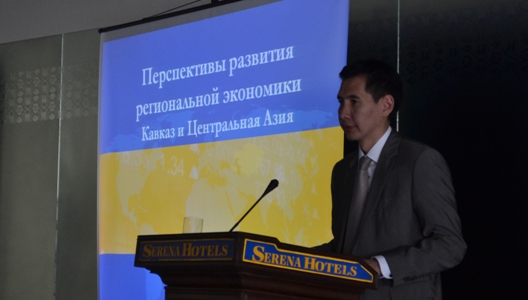
DUSHANBE, November 15, 2013, Asia-Plus /Zarina Ergasheva/ — Presentation on Caucasus and Central Asia Regional Economic Outlook (REO), which provides a comprehensive report on the prospects for growth in the region, took place in Dushanbe on November 14.
Economic activity in the Caucasus and Central Asia (CCA) is expected to continue expanding at a fast clip, with the CCA remaining among the fastest-growing regions in the world.
Growth is driven by a recovery in the hydrocarbon sector and firm growth in domestic demand, supported in part by stable remittance inflows.
Considerable downside risks weigh on this outlook, however, stemming in particular from a further slowdown in Russia, an important trading partner and source of remittance inflows.
CCA economies should take advantage of the favorable near-term economic conditions to rebuild fiscal policy buffers that were eroded after the global crisis. In some cases, more exchange rate flexibility would help shore up external buffers while supporting competitiveness. The positive near-term outlook is also an opportunity to strengthen policy frameworks and set in motion a process of structural transformation into dynamic emerging economies.
The International Monetary Fund (IMF) expects a slowdown in Russia to create risks for economic growth in Tajikistan.
We will recall that 1.678 billion U.S. dollars have been remitted from Russia to banks in Tajikistan over the first six months of this year.
In 2012, 3.8 billion U.S. dollars were reportedly remitted from Russian to banks in Tajikistan.
In 2012, remittances to Tajikistan amounted to some 50 percent of the country’s gross domestic product (GDP).
In 2011, remittances from Russia to Tajikistan reportedly totaled some 3 billion U.S. dollars.
Strong economic growth in the CCA is expected to continue in 2013–14, at about 6 percent, reflecting in part a continued catching up from low per capita income levels in many countries.
Growth is supported by the expansion of production in extractive sectors, accommodative fiscal policy, and remittance inflows, which have so far held up well despite a slowdown in Russia.
Growth in the CCA oil and gas exporters is projected to pick up slightly, underpinned by higher hydrocarbon production.
Growth in the CCA oil and gas importers is projected to soften temporarily in 2013, reflecting weaker external demand and bottlenecks in budgetary spending in the Caucasus.
Most countries in the CCA region reportedly need to consolidate their budgets to ensure fiscal sustainability and build sufficient policy buffers.
IMF projects a significant deterioration in fiscal positions in 2013–14, reflecting lower oil prices and, in some countries, higher expenditures and challenges in implementing tax reforms.
All CCA economies need to find room for more social spending in support of inclusive growth, such as greater investment in education and enhanced social safety nets.
In many countries, these policies should be supported by more exchange rate flexibility, to help strengthen external buffers as well as competitiveness and address vulnerabilities arising from high dollarization.
The current broadly positive outlook is also an opportunity to strengthen policy frameworks and set in motion the process of structural transformation into dynamic emerging economies. Further substantial improvements are needed in protecting property rights and investors, fighting corruption, encouraging competition, reforming labor market regulation while maintaining adequate social protection, strengthening education systems, fostering financial development, promoting regional and international trade integration, and strengthening fiscal and monetary policy frameworks.
“In 2014, growth rates are expected to rise in all countries of the region, except Tajikistan and Kyrgyzstan, and growth will be at an average of 5.5 percent if it is supported by increase of private investments and external demand, on condition that all planned measures of policy are fully implemented,” the IMF Resident Representative in Tajikistan Aidyn Bibolov said.
“As far as the market commodities are concerned, their prices remain quite uncertain for producers.
Gradual reduction of gas and oil prices will put a certain strain on some producers.
Tajikistan may feel the effect of reduction in prices of market commodities, because it also produces market commodities such as aluminum and cotton,” Bibolov noted.
