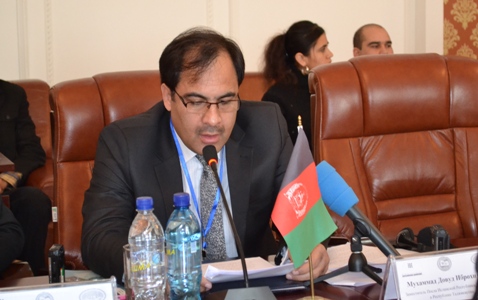
DUSHANBE, December 18, 2013, Asia-Plus — Afghanistan is not yet ready to sign a security pact with the United States.
Mohammad Davoud Ibrahimkhel, Deputy Chief of Mission of Afghanistan in Tajikistan, stated this at a conference in Dushanbe on December 17.
Organized by the Center for Geopolitical Studies of Russian-Tajik Slavic University (RTSU) under support of the Russian Embassy in Dushanbe, the conference entitled “Russia and Central Asia’s Nations: Political, Economic and Humanitarian Aspects of Eurasian Integration” discussed cooperation between Tajikistan and Russia and problems of implementation of national interests of the Central Asian countries under conditions of geopolitical alternatives.
“The United States has conducted the policy of double standards and non-transparent policy leads to mistrust,” Afghan diplomat noted.
According to him, the United States came to Afghanistan after 9/11 attacks under the pretext of providing assistance to Afghanistan and “a new epoch has started in Afghanistan’s history since that time.”
“The current number of Taliban militants is estimated at 25,000 to 30,000. Although Afghan authorities have repeatedly stated that Taliban’s bases are outside Afghanistan, the United States has been continuing military operations in the territory of our country,” Mohammad Davoud Ibrahimkhel stated.
“Time has passed and we have understood that the United States is not quite with us,” Afghan diplomat said.
He noted that the United States was pursuing its own ends in the Central Asian region: control over energy resources; preventing growth in influence of Russia and China in the region; strengthening its positions in the region; and preventing spread of Islamic extremism.
Meanwhile U.S. media resources note that Afghan President Hamid Karzai has refused to finalize the pact without further amendments while the Americans insisted on a deal by the end of this year to allow the military time to reorganize for a revised role when the NATO combat mission in Afghanistan ends in December 2014.
According to the New York Times, Mr. Karzai said he might not sign the agreement until after the election of his successor, next April, and imposed new conditions on American and allied military actions, including an immediate and total ban on counterterrorism raids by American forces on Afghan homes. He has also mentioned freeing prisoners held by the United States at Guantánamo Bay as a condition for signing the agreement.
Reuters reports that U.S. officials say further delay in clinching the agreement might force Washington to consider a “zero option” in which all U.S. forces would be withdrawn next year.