DUSHANBE, February 18, 2014, Asia-Plus — The next meeting of the intergovernmental council of four countries, which are part of the Central Asia South Asia Electricity Trade and Transmission Project (CASA 1000), is taking place in Washington today.
According to the Ministry of Energy and Water Resources (MoEWR), government delegations of Tajikistan, Kyrgyzstan, Afghanistan and Pakistan as well as representatives of the World Bank, Islamic Development Bank (IsDB) and other potential investors are participating in the meeting.
The Tajik delegation is led by the First Deputy Prime Minister, Davlatali Saidov, and the sides are expected to sign a number of documents, an official source at a MoEWR said.
According to him, three-day negotiations to discuss the project financing issues will start in Washington on February 19.
“The sides are expected to discuss an agreement between Tajikistan and the World Bank on funding the construction of the Tajik section of the CSA 1000 transmission line,” the source said, noting that the agreement is expected to be signed in April this year.
Tajikistan, Kyrgyzstan, Afghanistan and Pakistan have reportedly already signed an inter-governmental council resolution that defines project structure and key commercial principles, signaling their commitment to developing the project this year.
Meanwhile,
The Express Tribune
(Pakistan) reported on February 12 that according to a study the cost of power transmission is estimated at 3.37 cents per unit, which will go up to 7.26 cents by 2030. The levelised cost – the price at which electricity must be generated from a specific source to break even over the lifetime of the project – will be 5.38 cents per unit for 15 years and 4.94 cents for 30 years.
Projected sale price of Tajikistan is 1.5 cents per unit and of Kyrgyzstan is 2.5 cents per unit,
The Express Tribune
noted.
It also reported that according to Tajik Embassy in Islamabad Tajikistan after being disconnected from Central Asia’s energy grid has no other option but to sell surplus electricity in the summer to South Asian countries. It will also help build close economic relations with Kyrgyzstan, Afghanistan and Pakistan. “It will help Afghanistan demonstrate its viability as a transit country linking the two regions,” the embassy was quoted as saying.
It reportedly said that Canadian company SNC Lavalin, which has conducted the feasibility study, justified the viability of CASA-1000 based on the current and projected volume of spill water of hydropower plants in Tajikistan in the May-September period.
According to calculations, even in conservative prospect without taking into account the growth of energy generation until 2035, there will be sufficient volume of energy and water resources to maintain the required electricity generation needed for CASA-1000,
The Express Tribune
said.
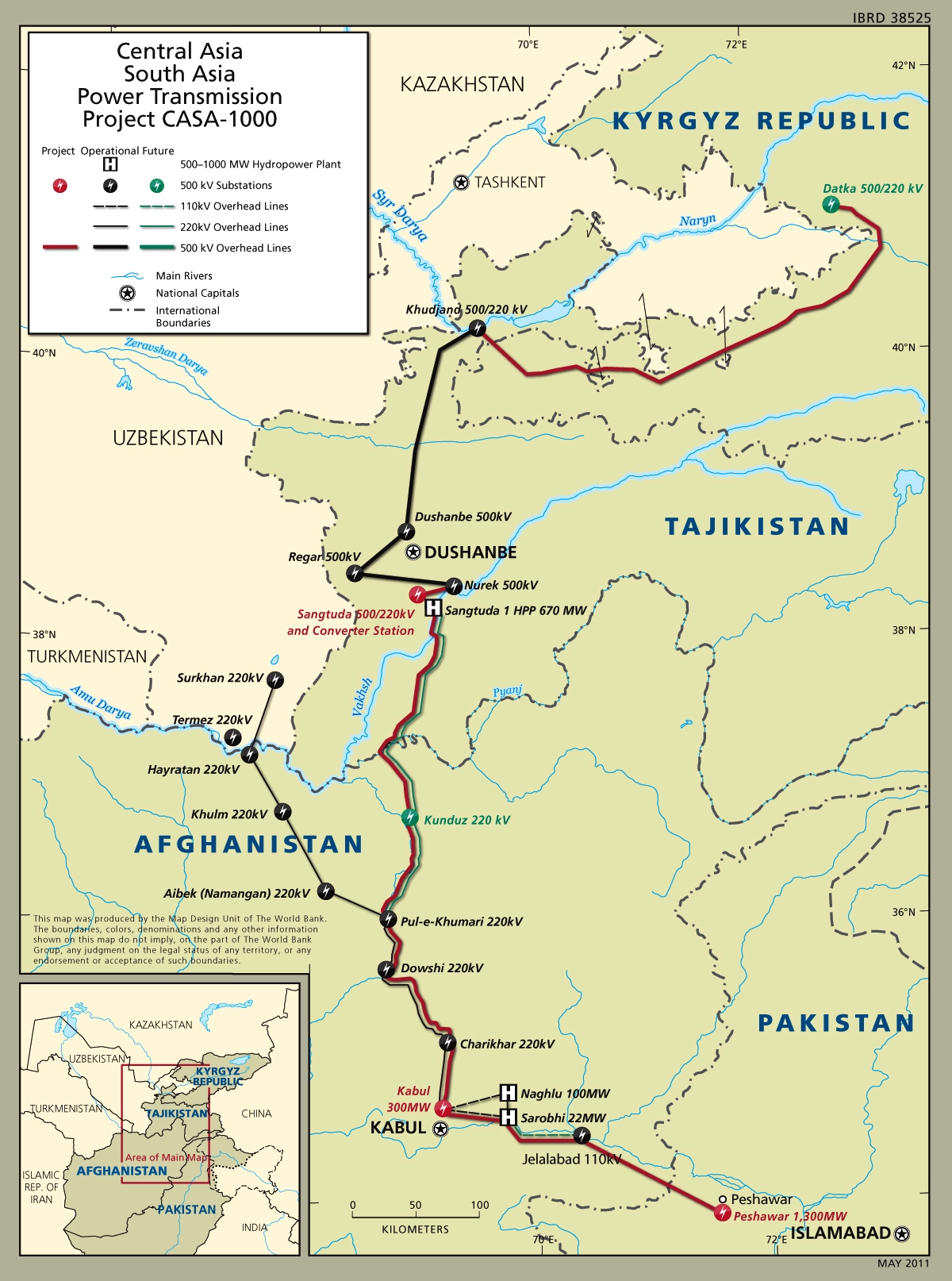
CASA 1000 is designed to transmit 1,300MW of surplus electricity from Tajikistan and Kyrgyzstan through Afghanistan, which is going to consume 300MW, to Pakistan.
The CASA 1000 Project is expected to develop the necessary physical infrastructure and create the institutional and legal framework to transmit surplus power available from existing generation facilities in Tajikistan and Kyrgyzstan to Afghanistan and Pakistan. The physical infrastructure for CASA 1000 is likely to include: a 500 kV high voltage direct current (HVDC) transmission system between Tajikistan and Pakistan through Afghanistan; an AC transmission link from Kyrgyzstan and Tajikistan to connect to the HVDC line from Tajikistan to South Asia; and the necessary electricity sub-stations in Kabul, Peshawar and Sangtuda (in Tajikistan).