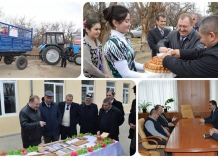
KHUJAND, December 10, 2015, Asia-Plus – A ceremony of handover of agricultural machines to the base of Tajikistan’s Academy of the Agricultural Sciences in Sughd province took place in the Kulkent jamoat of Isfara on December 9.
Iqbol Teshayev, a spokesman for the Isfara mayor’s office, says one Belarus tractor with a trailer, a cultivator and tractor-drawn plow, were handed over to the base in the presence of Valery Bondarenko, Russian General Consul in Khujand, Maqsoud Aripov, Manager of UNDP Area Office in Khujand, and senior representatives from the Isfara mayor’s office.
Established in 1969, the base is an experimental station of the Institute of Horticulture and Plant Cultivation at the Academy of the Agricultural Sciences of Tajikistan.
The agricultural machines were handed over to the base in the framework of a three-year initiative, Livelihood Improvement of 1,000,000 Rural Population in 9 Districts of Tajikistan.
We will recall that a grant agreement to support this initiative was between the Government of the Russian Federation and UNDP Country Office in Tajikistan in Dushanbe on November 4, 2014.
The Initiative aims at addressing local development priorities in nine districts of Sughd and Khatlon provinces and thee Districts Subordinate to the Center. The project assists the local authorities in the effective planning and monitoring of social and economic development of the target districts through elaboration of new and review of existing District Development Programs and in implementation of about 50 priority initiatives emanating from these Programs. In addition, the project promotes employment and entrepreneurship development. Improving the business environment through creating public-private dialogue platforms at the local level, as well as enhancing the capacity of local authorities and business structures on local economic development issues is at the focus of the project.
The project also actively contributes to improving people’s access to financial resources to support development of private entrepreneurship, new productions and jobs creation.
The project facilitates development of the labor market through rendering support and advancing vocational education at the local level. More than 500 people will have an opportunity to learn new professional skills demanded at the local and external labor markets. Overall, the project will support the livelihood improvement of more than 1 million population of Tajikistan.