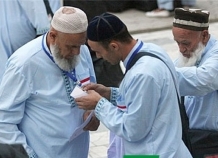
DUSHANBE, May 6 2016, Asia-Plus — This year, Hajj, the Muslim pilgrimage to Mecca, will cost Tajik nationals at 28,649.1 somoni (equivalent to more than 3,500 U.S. dollars) which is more than 5,000 somoni more than last year, according to the Committee on Religious Affairs (CRA) under the Government of Tajikistan.
This amount reportedly includes travel expenses, board and lodging, special clothing with the national flag, purchase of animal for sacrificing, guide services, medical insurance, vaccinations, etc.
Actually, the Hajj cost did not change compared to last year, but because of sharp depreciation of the national currency, the somoni, the difference in amounts in the somoni is tangible.
The number of people from Tajikistan allowed to perform the Hajj, this year is 6,000.
We will recall that Tajik authorities have introduced new age restrictions for those who want to perform the Hajj. Citizens under the age of 40 will no longer be allowed to perform the Hajj.
According to the CRA representatives, the aim of the decision to introduce new age restrictions is to give older people an opportunity to achieve their dream to perform the Hajj.
The new age limit of 40 has been raised from the limit of 35 that was instituted in April last year.
For the first time the CRA introduced age restrictions on those who want to perform the Hajj in 2010. Only citizens aged 18 to 80 were able to perform the Hajj.
Last year, the number of people from Tajikistan allowed to perform the Hajj was 6,300. In 2015, Tajik pilgrims had to pay 3,600 U.S. dollars for the Hajj.
The Hajj is the annual pilgrimage to Mecca, Saudi Arabia. It is currently the largest annual pilgrimage in the world, and is the fifth pillar of Islam, a religious duty that must be carried out at least once in their lifetime by every able-bodied Muslim who can afford to do so. The Hajj is a demonstration of the solidarity of the Muslim people, and their submission to God. The pilgrimage occurs from the 8th to 12th day of Dhu al-Hijjah, the 12th and last month of the Islamic calendar. Because the Islamic calendar is a lunar calendar, eleven days shorter than the Gregorian calendar, the Gregorian date of the Hajj changes from year to year.