The Ministry of Agriculture of Tajikistan has received substantial support for strengthening national capacities on locust management.
Substantial locust survey and monitoring equipment, amounting more than USD 1.2 million, was officially handed over by the Food and Agriculture Organization of the United Nations (FAO) to the Ministry of Agriculture (MoA) of Tajikistan, during a ceremony held in Dushanbe on March 10.
This support was provided in the framework of a FAO regional project funded by the Government of Japan and the Japan International Cooperation Agency (JICA) and aiming at improving locust management in Afghanistan, Kyrgyzstan and Tajikistan.
According to FAO Office in Tajikistan, the ceremony was attended by Mr. Hajime Kitaoka, Ambassador Extraordinary and Plenipotentiary of Japan to Tajikistan, Mr. Izatullo Sattori, Minister for Agriculture, Mr. Viorel Gutu, FAO Representative in Tajikistan, Mr. Hideki Tanabe, Chief Representative, JICA Tajikistan Office, the head and the experts of the direct beneficiary organization, the State Entity Enterprise “Locust Control Expedition” (SE-LCE) of MoA of Tajikistan.
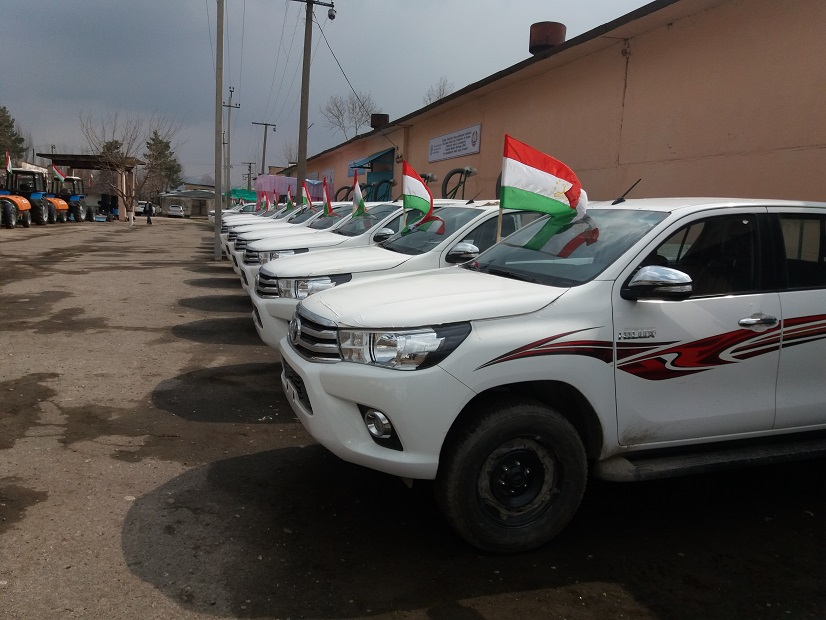
The equipment delivered in order to strengthen locust monitoring and thus contributed to prevent crisis, comprises: four vehicles, 37 motorbikes, positioning and communication equipment, 40 tablets to facilitate field data collection as well as office equipment. Locust control equipment includes 15 vehicles, five tractors together with five sprayers, Ultra-low volume (ULV) sprayers (20 vehicle-mounted and 70 knapsacks), 10 pesticide transfer pumps, as well as pesticides in ULV formulation – the technique using this formulation being world-wide recognized as the most efficient and the least harmful for locust control, when appropriately applied by well-trained staff using properly calibrated sprayers. Delivery of additional equipment is on the way, including two prefabricated houses for meetings and trainings, entomological kits, personal protective equipment, human health and environment monitoring equipment, etc.
Along with such equipment, knowledge and capacities of staff are being strengthened thanks to the project. To that end, activities are being organized such as a Training-of-Trainers on locust management, development of practical guidelines on pesticide risk reduction (which will complement monographs on the locust pests and other guidelines produced against other funding), technical and operational support to the national Human Health and Environment Monitoring Team.
The project also supports regional cooperation, as it is crucial for the successful management of such trans-boundary plant pests. Cross-border locust surveys, for instance, are carried out with neighboring countries as well as other joint activities.
The three-year project funded by the Government of Japan and JICA, which started in December 2015 to the benefit of three Central Asian countries, has an overall budget of USD 4.85 million. It is part of the FAO multi-funded program to improve national and regional locust management in Caucasus and Central Asia (CCA), which was launched in 2011 to the benefit of ten countries of the region: Afghanistan, Armenia, Azerbaijan, Georgia, Kazakhstan, Kyrgyzstan, Russian Federation, Tajikistan, Turkmenistan and Uzbekistan.
The program’s main objective is to contribute to food security and livelihood of the rural populations in Central Asia by preventing and limiting the threats posed by locusts and damage to crops and rangelands in the respect of human health and the environment. The expected outcome is that national and regional locust management will be improved in Caucasus and Central Asia, through the development of increased national capacities and regional cooperation.