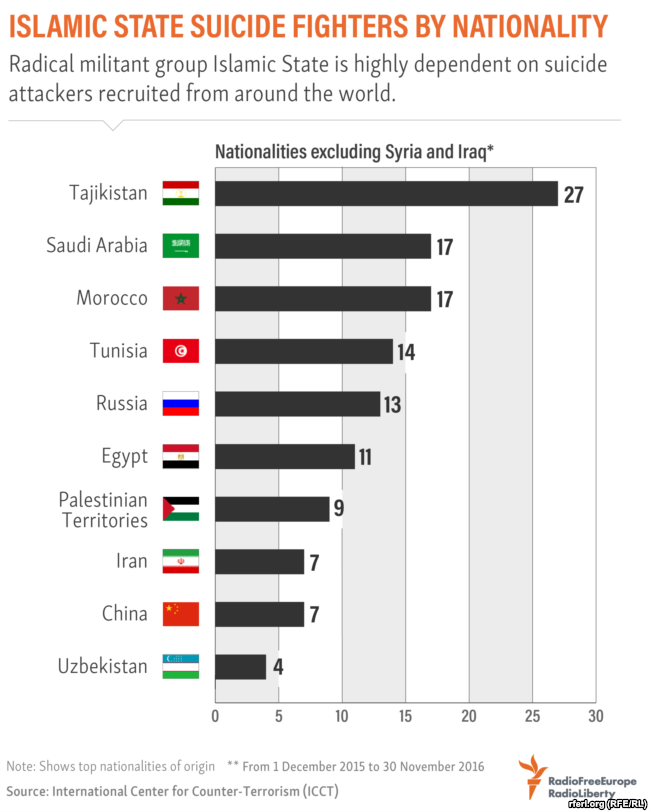
An article “Tajikistan’s Deadly Export” posted on Radio Liberty’s website says Tajikistan came out on top in a recent report listing the origins of suicide bombers sent to Iraq and Syria, on whose territory Islamic State (IS)'s diminishing so-called caliphate stands.
The report by The Hague-based International Center for Counter-Terrorism (ICCT) claimed that 27 Tajiks had carried out suicide operations in Iraq and Syria from December 2015 to November 2016, the highest among all foreign individuals whose country of origin had been identified.
The report — War by Suicide: A Statistical Analysis of the Islamic State's Martyrdom Industry — has put the spotlight on Tajikistan's struggle against extremism and why Tajiks would be so significantly represented among IS suicide bombers.
Tajik's Interior Ministry said in January that around 1,100 of its citizens were fighting in Syria and Iraq. At least 300 of them have reportedly been killed there, according to Dushanbe, while more than 60 have returned home voluntarily and been pardoned by the authorities under a blanket amnesty.
Charlie Winter, the author of the ICCT report, says Tajiks are “disproportionally represented” on the list of suicide bombers because the number of Tajiks joining IS pales in comparison to that of citizens of some other countries. For example, 6,500 Tunisians and 2,500 Saudis are estimated to have joined IS.
Winter says that the statistics suggest that “Tajiks were being singled out for use in suicide attacks at least in part because of their nationality.”
Analysts say the case of a high-ranking, U.S.-trained, Tajik special-forces commander who vacated his post and defected to IS in Syria could help answer the question as to why so many Tajiks are being used as suicide bombers.
Colonel Gulmurod Halimov, the former commander of the Tajik Interior Ministry's special forces known as the OMON, reportedly joined the IS extremist group in 2015. Counterterrorism experts believe Halimov has risen through the ranks to become the top IS military commander.
“Why Tajiks have been used so frequently could be because Halimov is reported to be the IS supreme military commander,” says Edward Lemon, a fellow at Colombia University who researches Tajikistan. “It is possible that Halimov is behind the move to use Tajiks more frequently by persuading them to volunteer.”
Analysts also suggest pressure exerted by Tajikistan's government on Islamic political and religious groups and unsanctioned Islam has played into the hands of IS recruiters.
The effort to deter citizens from Islam not in keeping with the official line, analysts note, may have pushed some believers to more dangerous streams of the religion.
“When the Islamic Revival Party of Tajikistan (IRPT) was part of the [government] one of their main tasks was to educate people not to go to IS,” says Sophie Roche, a researcher at the University of Heidelberg, in Germany. “Once [the party] was forbidden we had an enormous increase [of Tajiks joining IS] — students and, in one case, 40 people from one village.”
Analyst Lemon says IS recruiters often target individuals who are socially isolated or have experienced some form of trauma or personal crisis.
He adds that the vast majority of recruitment takes place in Russia, where millions of Tajik citizens work as migrant laborers.
Researcher Roche says the sense of “humiliation” they feel over their situation plays an important role in recruitment in Russia, where migrant workers often perform menial jobs and are often targeted for abuse and harassment.
“Most of the migrants do work which is very post-colonial and they have a loss of status in that country,” says Roche, who has researched Tajik migrants in Russia.
“If you fail in Russia because you don't have a job or you don't earn enough to really build a status you turn toward religion to gain respect,” says Roche, although she adds that few who turn to Islam join the ranks of IS militants.