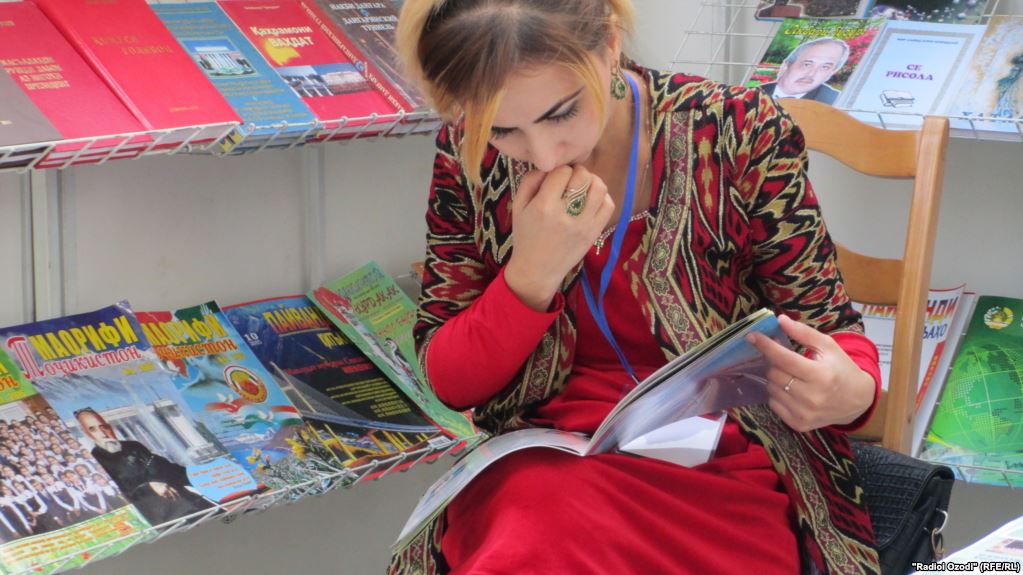
Tajikistan’s Ministry of Culture recently announced that no books are allowed in or out of the country without written permission, part of a stated effort to prevent valuable manuscripts from being smuggled out of the country, according to Radio Liberty’s Tajik Service.
"Regardless of the number of books, authorization from the Culture Ministry is required," Sherali Khojayev, the head of the ministry’s department for the protection of cultural heritage, told RFE/RL's Tajik Service. “The requirement applies to [travelers to and from] all countries, regardless of the language or script of the books.”
Despite that last comment, however, the move has led some to come to the conclusion that it is really intended to stop the dissemination of extremist religious material and could mean that books written in languages like Farsi and Arabic could fall under particular scrutiny.
Said Yusufi, a Dushanbe-based expert on social affairs, says the Tajik government is seriously concerned about preventing extremist literature from entering the country.
“However, since many of the customs employees can't read the Arabic-Farsi script, every book with such script can be treated with suspicion,” Yusufi adds. “In some instances, the customs officials seized entirely 'harmless' books.”
The Customs Service recently confirmed that a copy of Bustan, a famous work by the renowned medieval Persian poet Saadi Shirazi, had been seized from an unidentified Tajik citizen traveling abroad.
The customs office said in March that the book was confiscated along with three others — including a book on interpretations of dreams and a book of spells. All four books were in the Arabic script.
Despite the recent announcement by the Culture Ministry, however, travelers at the Dushanbe airport said they had not attracted additional scrutiny despite having books in their luggage.
Scanning machines are installed both in departure and arrival halls at Dushanbe's international airport, and staffers routinely scan both carry-on and checked luggage. Some passengers say customs officials randomly select bags or suitcases for additional searches.
Khojayev described the process for obtaining written permission to take a book out of the country as a simple procedure. You only need to fill out an application “citing the name of the books, stating their language, the place of publication, the name of the authors, and the country of origin or destination,” he said.
Arriving passengers whose books have been seized at airports or other border-entry points are advised to submit a similar application to the ministry to reclaim their confiscated goods — that is, if the authorities have determined that the material is allowed.
Tajikistan's state religious-affairs committee and the Interior Ministry have compiled a blacklist of banned books, most of them religious in nature, but also including books of spells.
In 2015, the country updated the list, adding 13 books alleged to promote the fundamentalist Salafi branch of Islam.
Tajikistan’s Supreme Court banned Salafism in 2009, deeming it a threat to the country’s security and stability.
The Koran and other Islamic books, such as manuals to Islamic prayers, are freely available in bookstores across the county.