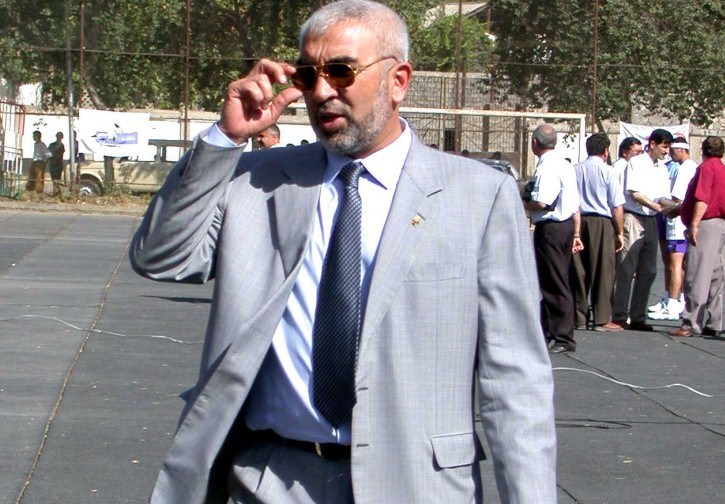
Ghaffor Mirzoyev, who was one of the most powerful among the pro-government warlords during the civil war in Tajikistan (1992-1997), has gone on hunger strike to protest government’s unwillingness to review his case, Radio Liberty’s Tajik Service reported citing Mirzoyev’s sister, Oisha Mirzoyeva.
“On July 26, representatives of the detention center, where Ghaffor is being held, called me and said that Ghaffor went on hunger strike on July 22 to protest the authorities’ unwillingness to review his case,” Oisha Mirozeyva was quoted as saying by Radio Liberty’s Tajik Service.
Meanwhile, representatives of the detention center have not confirmed that information.
Oisha Mirzoyeva says Ghaffor Mirzoyev has written a letter to Ozoda Rahmon, the chairperson of President’s Executive Office, asking to review his case.
Oisha Mirzoyeva is convinced that her brother’s letters regarding the re-examination of his case do not come to the president’s office and other government bodies.
“He is supporter of the state and he insists on re-examination of his case. He has repeatedly applied with such solicitations to the Parliament, the Constitutional Court and other echelons, but as he says his application have not even gone out of the jail," Oisha Mirzoyeva told Radio Liberty’s Tajik Service in an interview.
Recall, the Supreme Court of Tajikistan on August 11, 2006 sentenced Ghaffor Mirzoyev, the former commander of Tajikistan’s Presidential Guards and the former director of the Tajik Drug Control Agency, to life imprisonment.
Ghaffor Mirzoyev was found guilty of planning a coup, tax evasion, illegally crossing border, and abuse of office.
Other defendants that were together with Ghaffor Mirzoyev in the dock were sentenced to lengthy terms in jail, ranging from 12 to 16 years.
The trial of Ghaffor Mirzoyev ended on August 3. In July, a prosecutor in the trial of Ghaffor Mirzoyev asked the court to sentence Ghaffor Mirzoyev to death.
Ghaffor Mirzoyev did not plead guilty to any of the charges, which included sedition and murder.
Ghaffor Mirzoyev commanded the presidential guard between 1995 until his dismissal in January 2004. In addition to being the chief of the Presidential National Guard, Mirzoyev served as the head of Tajikistan's National Olympic Committee in 2002. He had also been the head of the country’s counter narcotics agency.
Ghaffor Mirzoyev was arrested along with 15 supporters on August 6, 2004, and he faced numerous charges, including abuse of office, tax evasion, and planning a coup. Though many claimed that the arrests were politically motivated, most critics still conceded that Mirzoyev was a “corrupt official” with links to the narcotics industry.