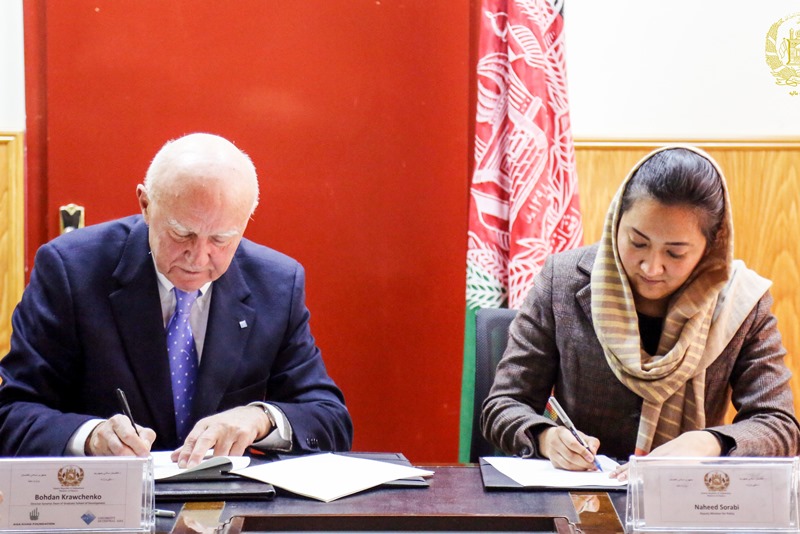
“The Executive Masters Program in Economic Policy will help build a strong foundation in economic analysis and management skills for Afghan civil servants who are working as policy analysts, and implementing Afghanistan’s National Peace and Development Framework,” said Naheed Sorabi, Deputy Minister of Finance of Afghanistan who also heads the Policy Department.
She was speaking at the signing ceremony of the agreement by the Afghan Government and the University of Central Asia (UCA) on December 17, 2017 in Kabul.
Press release issued by UCA says that according to the Memorandum of Understanding, by 2020 a total of 40 employees of the Afghan Government are expected to receive an Executive Masters in Economic Policy from UCA’s Institute of Public Policy and Administration. The Program is designed to build a strong foundation in economic theory and its applications, quantitative methods, and basic tools of management analysis. The agreement was signed on behalf of UCA by Dr. Bohdan Krawchenko, Dean of the Graduate School of Development. “The Ministry of Finance is where policy making and financial authority connect,” he said, “and we are delighted to have this opportunity to engage with our Afghan colleagues in the exploration of economic policy.”
This partnership complements existing programs in Afghanistan offered by UCA through its School of Professional and Continuing Education, the Mountain Societies Research Institute, and the Institute of Public Policy and Administration. UCA’s cross-border and regional initiatives aim to improve the quality of life of the local communities, and promote economic, educational and cultural cooperation through quality education and research programs.
Previously, in 2015, a similar collaboration resulted in 26 Afghan Government staff receiving a Certificate in Policy Analysis at UCA; a program which had been designed in collaboration with Carleton University in Canada.
The University of Central Asia was founded in 2000 as a private, not for profit, secular university through an International Treaty signed by the Presidents of Kyrgyzstan, Tajikistan, and Kazakhstan, and His Highness the Aga Khan; ratified by their respective parliaments, and registered with the United Nations. The Presidents are the Patrons of the University, and His Highness is the Chancellor. UCA’s mission is to promote the social and economic development of Central Asia, particularly its mountain communities, by offering an internationally recognized standard of higher education, and enabling the peoples of the region to preserve their rich cultural heritage as assets for the future. UCA is supported by the commitment and partnership of the Aga Khan Development Network.