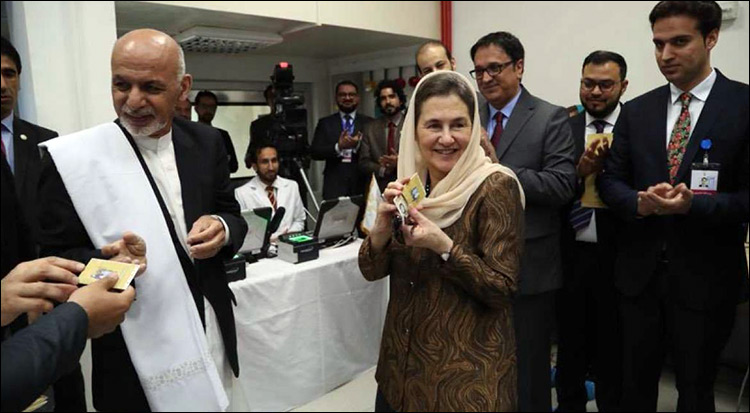
The electronic national ID card system was officially launched in Kabul on May 3 when President Ashraf Ghani and the First Lady Rula Ghani were handed their cards, according TOLONews.
The new electronic ID cards are expected to help reduce the number of fake IDs (Tazkiras) in circulation, the president said yesterday.
Speaking at the event, Ghani said the roll out of the new system was in line with attempts to tighten security.
He said the new ID cards would hopefully cut down on the number of fake Tazkiras in the country.
“One of the key reasons why we have started this process is because of Monday’s terrorist attacks. It is very possible that the attackers used fake IDs. The key decision for me is the security of the people and we must know who are Afghans,” Ghani said.
He also said government is taking the elections seriously and called on the people to register to vote for October’s elections.
Ghani also extended his condolences to the families of the victims of Monday's attack.
Two suicide bombers killed almost 30 people in the double bombing in Shash Darak on Monday. Nine journalists were also killed in the incident.
The journalists had been targeted after rushing to the scene of the first explosion. Officials said the second suicide bomber had shown a press pass and posed as a journalist before detonating his explosives.
TOLONews says Humayoun Mohtat, Director of Biometric Identity Cards Issuing Authority (BICIA), said at a process conference on March 29 that the government has given them 90 days to start issuing electronic identity cards to the public.
According to him, 500,000 Afghans have already been identified and will receive the national identity cards in the first phase.
He said that 36 particulars of each person will be entered into the data base, of which eight will be printed on the card.
The budget for the initial phase amounts to $4.2 million USD, which will be covered by the Ministry of Finance, he added.
He stressed that the National Unity Government (NUG) is committed to rolling out this process.
The issuing of the electronic identity cards is deemed as a major step towards holding transparent and fair elections in the country.
The e-NIC department said in late March that at least $70 million USD has been spent on the process so far.