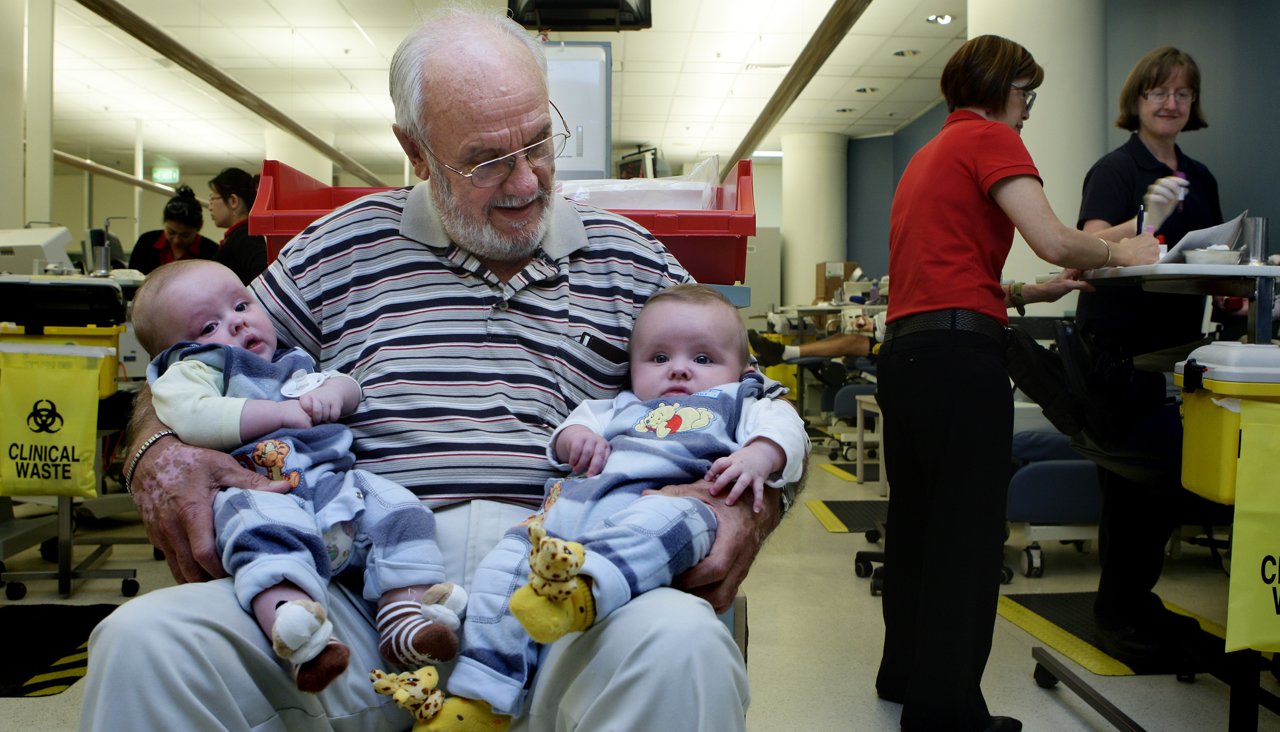
‘The man with the golden arm', who donated blood every week for 60 years, saving the lives of 2.4 million babies in Australia, retires aged 81.
After helping to save the babies of more than two million Australian women, an 81-year-old blood donor with a precious antibody has officially ‘retired’ from his selfless duty.
Media reports say James Harrison, dubbed the ‘man with the golden arm’, has provided 1,117 bags of vital blood which contain an antibody in his plasma, and stops babies dying from Rhesus disease, a form of severe anemia.
The antibody is used to make a lifesaving medication, Anti-D, as it is given to pregnant mothers whose blood is at risk of attacking and killing their unborn babies.
The Telegraph reports Mr. Harrison was asked to donate in the 1960s, shortly after scientists in Australia discovered that his blood type could help to prevent a condition that can cause severe – and potentially fatal – anemia in babies.
More than three million doses of Anti-D containing Mr. Harrison’s blood have reportedly been given to Australian mothers with a negative blood type since 1967.
The Red Cross Blood service in Australia examined birth data since 1964 as well as the proportion of women receiving Anti-D injections and the risk of infant mortality, calculating that Mr. Harrison had prevented 2.4 million deaths.
After donating for the last time on May 11, Mr. Harrison issued a challenge to others to break his incredible record, ‘because it will mean they are dedicated to the cause'.
His ‘golden arm’ has even helped his own daughter, Tracey, give birth to a healthy son, thanks to her father’s precious blood.
When Mr. Harrison started donating, his blood was deemed so special that his life was insured for one million Australian dollars.
Mr. Harrison is one of about 50 people in Australia known to have the antibodies.
His generosity as a continuous donor stems from a brush with death at the age of 14, when he had a chest operation, and committed himself to helping others by giving blood on a regular basis.
According to CNN, doctors are unsure why Mr. Harrison has this rare blood type, but they concluded that it might have been triggered from the transfusions he received while a teenager, after his operation, which saved his life.