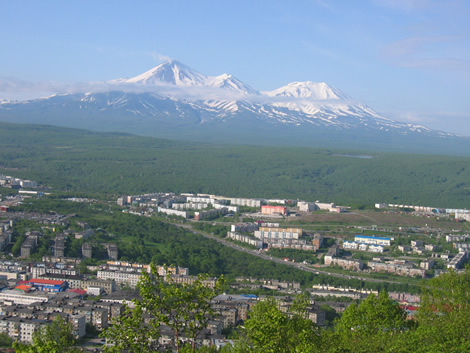
Kamchatka is the definition of remote, even in a vast country like Russia. Government subsidies dried up after the Soviet Union collapsed, driving a sharp rise in prices for basic necessities. This was especially felt in places like Kamchatka, where many goods have to be shipped in from great distances, according to EurasiaNet.org.
Since 1991, over 20 percent of Kamchatka’s population has emigrated, according to a recent briefing from the Carnegie Endowment. An estimated 10,000 have departed since the 2010 census alone. The population is now just above 300,000, with about six in 10 living in the regional capital, Petropavlovsk-Kamchatsky.
Today Central Asian labor migrants help staunch the population decline and keep critical industries afloat.
And unlike the hardships Central Asians often face in Moscow – police harassment, racism, bureaucratic hurdles – migrants seem to talk about Kamchatka with warmth.
“The police greet us every morning and shake our hands. In Moscow, they grab us and take us away,” said Mansur, a brawny Tashkent native who works in the timber and fishing industries and sells fruit whenever he returns from Uzbekistan. “I can make good money out here and not deal with the stresses of Moscow.”
Firouz, a 26-year-old from Samarkand, moved to Petropavlovsk two years ago, hoping to save enough to get married. He had been deported from Moscow for visa violations.
“There is a lot of work here and less pressure than in Moscow, with nicer people who are a lot more welcoming,” he told EurasiaNet.org. Depending on the season, Firouz splits his time working in a restaurant, in a fish factory and on construction projects. He reckons hundreds or thousands of Central Asians do the same.
According to Kamchatka’s official statistical service, international arrivals during the first five months of this year more than doubled over 2017, to 2,251 people. About 40 percent are from Central Asia, mostly Kyrgyzstan and Uzbekistan.
One lure is the wages. According to official data, they’re almost twice the average in other Russian cities.
Local government data show that more than 80 percent of budget revenues are derived from the fishing industry. There are also naval bases in Kamchatka, including Russia’s largest submarine fleet; the military plays a pivotal economic role in this strategic region jutting into the Pacific.
In recent years, the Kremlin has marketed Kamchatka as a sightseeing destination. Tourists help stoke the demand for a larger labor force. There is currently a push to repair and build new roads on the peninsula.
This development has boosted demand for labor migrants. Some come to Kamchatka for seasonal work; others stay all year.
Dilibek Kuchkarov, a trained electrician from Andijan, arrived last year with his wife after both worked in Moscow for several years. He found a job through other local Uzbeks, and earns more than he was paid in Moscow, he explained over tea in Samarkand Cafe, a local Uzbek eatery. Kuchkarov takes home 60 to 100 thousand rubles per month, depending on the season. Minus the 20 to 25 thousand he spends on an apartment, he’s able to save enough to travel home every year.