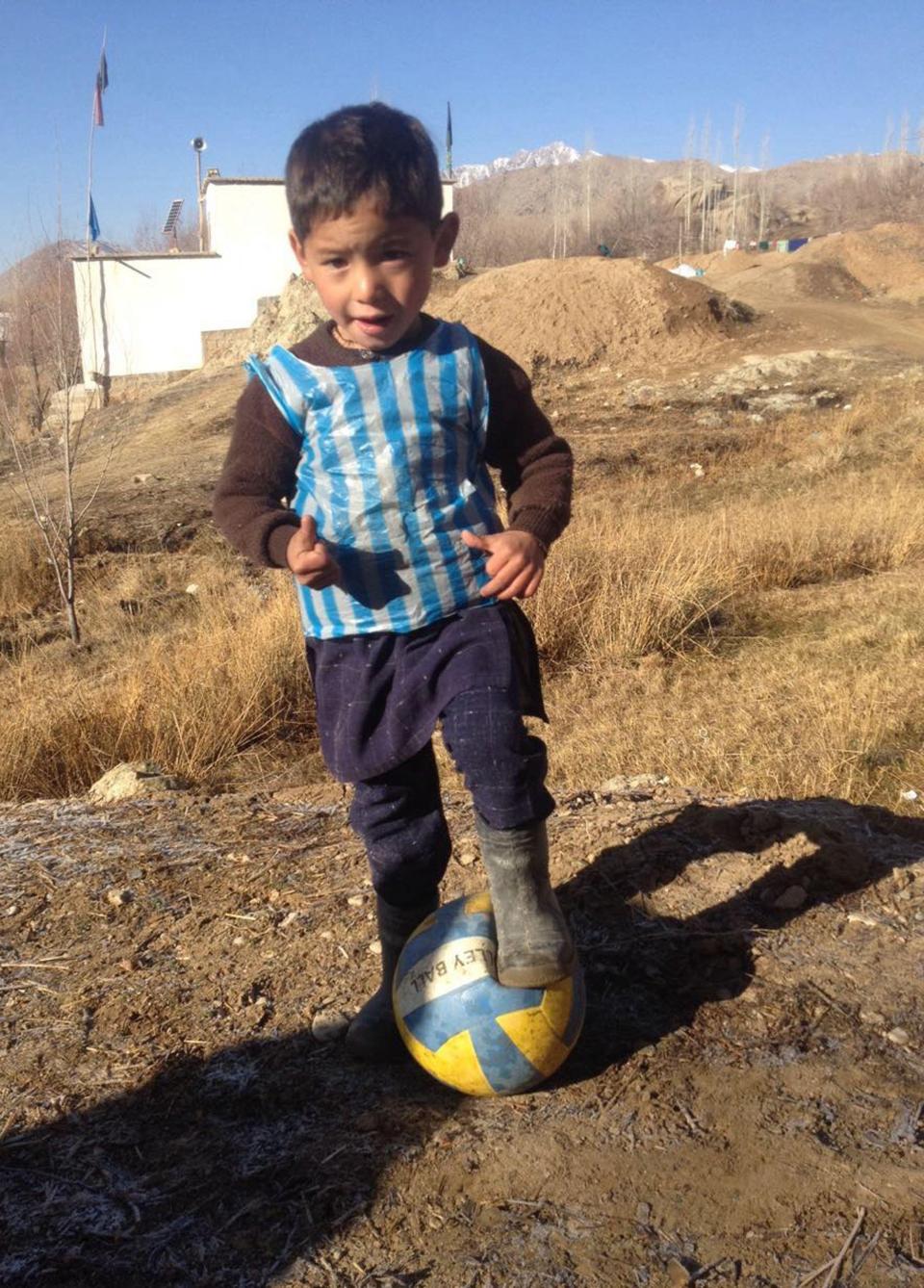
An Afghan boy, who shot to fame for wearing a plastic bag with soccer legend Lionel Messi's name and number, and eventually meeting his icon in person, is now homeless after being displaced by a Taliban offensive.
Murtaza Ahmadi became a global sensation in 2016 when a photograph of him wearing the blue and white striped plastic bag jersey, with "Messi 10" written on the back, went viral.
The seven-year-old Murtaza lived with his family in the Jaghori district of the southern Ghazni province, considered safe during most of the 17-year-long Afghan conflict.
But the relative calm was broken in early November when the Taliban attacked the area, forcing more than two-thirds of the population to flee.
"I miss our house in Jaghori. Here I don't have a ball. I can't play football or go outside," the seven-year-old told EFE, a Spanish international news agency, on December 4 in Kabul, where his family has been living for the past two weeks.
When he was asked about the two jerseys and a football, which Messi had signed and gifted to him in Qatar in 2016, he tearfully said, "We left them behind in Jaghori. We could not bring them, because we left the house in the dark of the night and (my) mother told me to leave the ball and shirts at home,"
Afghan security forces have driven out the rebels from the area, but the family has decided not to return home.
Even before the Taliban offensive, the family had been receiving continuous threats on phone due to their son's sudden fame, his elder brother Humayoon Ahmadi, 17, told EFE.
“After Murtaza met Messi in Qatar and returned home, life became difficult for us. We were living in fear because the people around us thought Messi had given us lots of money,” he said.
The family had fled to Pakistan in May 2016, hoping to get asylum in the United States. However, their asylum request was rejected and they were forced to return to the village, only to be displaced again.
An estimated 300,000 Afghans have reportedly been displaced this year alone and forced to live in difficult conditions, depending on aid from government and NGOs for their survival.