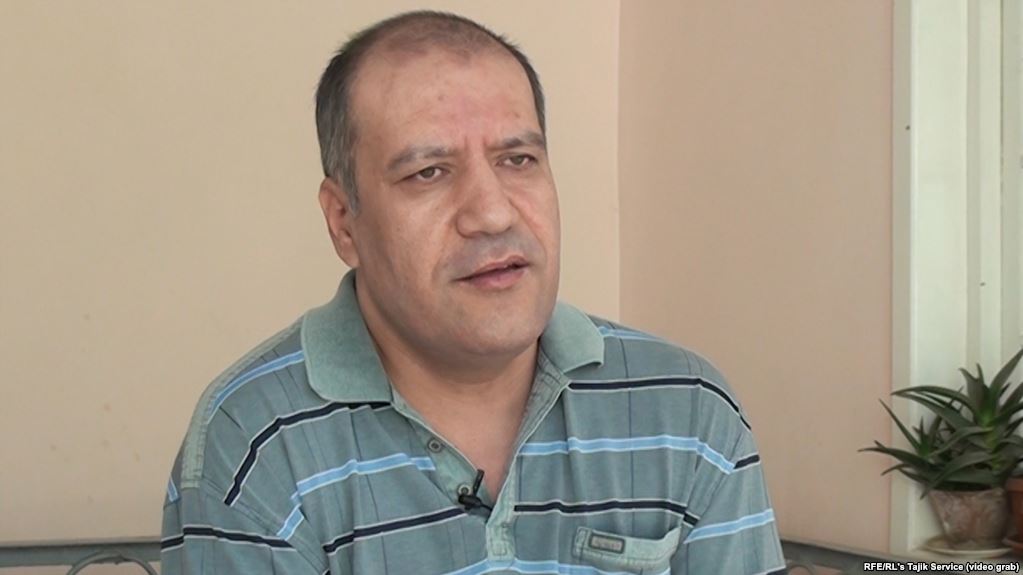
Tajik journalist has been sentenced to eight months in prison for breaching a court order and illegally leaving the country, his lawyer says.
Khayrullo Mirsaidov was sentenced in absentia by the Khujand city court on January 11, the lawyer told Radio Liberty’s Tajik Service.
Mirsaidov was released from prison in August 2018, after his 12-year sentence was converted to a $8,500 fine and community service in a case widely seen as politically motivated.
He was ordered to pay the state 20 percent of any official salary he receives in Tajikistan for the next two years.
"I told the court that Mirsaidov had left the country to get medical treatment abroad," defense lawyer Bakhtiyor Nasrulloyev told RFE/RL on January 12.
"But the officials protested that he had left without telling the authorities. They said he was required to provide medical documentation and obtain the authorities' permission to go abroad," Nasrulloyev said.
Mirsaidov's December 2017 arrest on financial charges brought condemnation from domestic and international groups — including Reporters Without Borders, the National Association of Independent Mass Media in Tajikistan, Human Rights Watch, and Amnesty International.
Mirsaidov said the charges were filed in retaliation for his critical reporting about government corruption.
His arrest came shortly after he had published an open letter accusing senior officials of corruption in his native Sughd Province.
Amnesty International at the time described him as "a prisoner of conscience who is being punished solely for exercising his right to freedom of expression."
He was sentenced on July 11 after being found guilty of embezzling and misusing state funds and of making false reports to police.
After his release under international pressure in August, Mirsaidov said he was unhappy with the court's ruling and insisted he should be acquitted of all charges, rather than having to face a fine and restrictions on his ability to earn a living in the future.
Mirsaidov is an independent journalist and a former correspondent of Asia-Plus and Germany's Deutsche Welle radio.
He also led the Tajik team for KVN, a stand-up comedy competition that originated among university students in the Soviet Union and is still popular in many former Soviet republics.