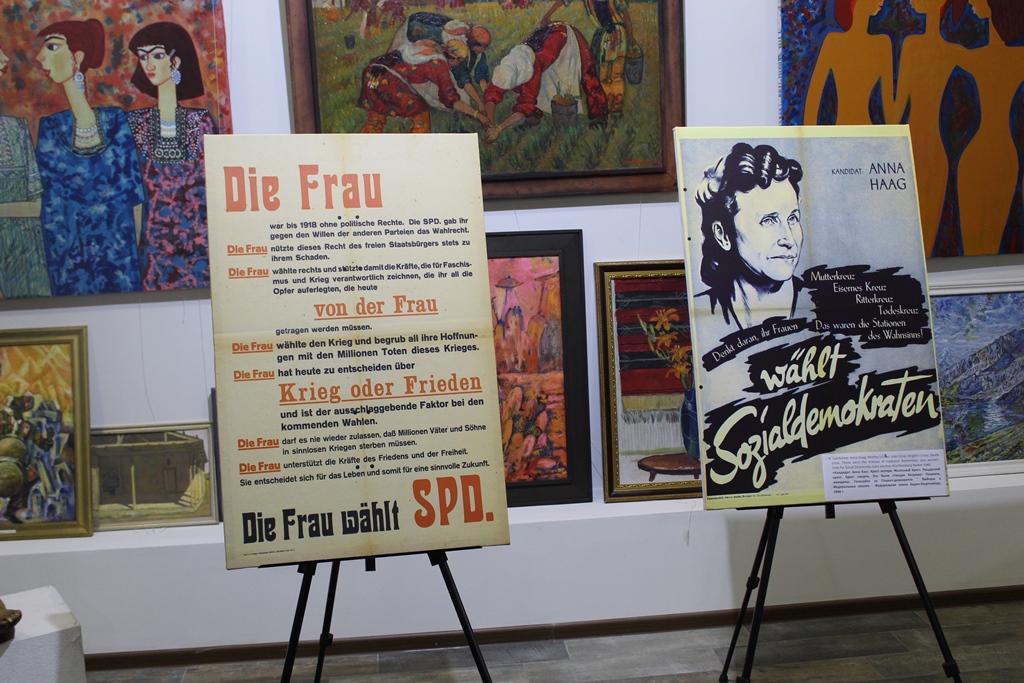
An exhibition of works dedicated to the 100th anniversary female suffrage in Germany opened at the Gallery of Modern Art in Dushanbe Mall on February 1.
Organized by the German Embassy in Dushanbe, the exhibition was attended by ambassadors of the European Union, France, Germany, Russia and Saudi Arabia to Tajikistan, senior representatives of international organizations active as well as experts in fine arts and representatives of media.
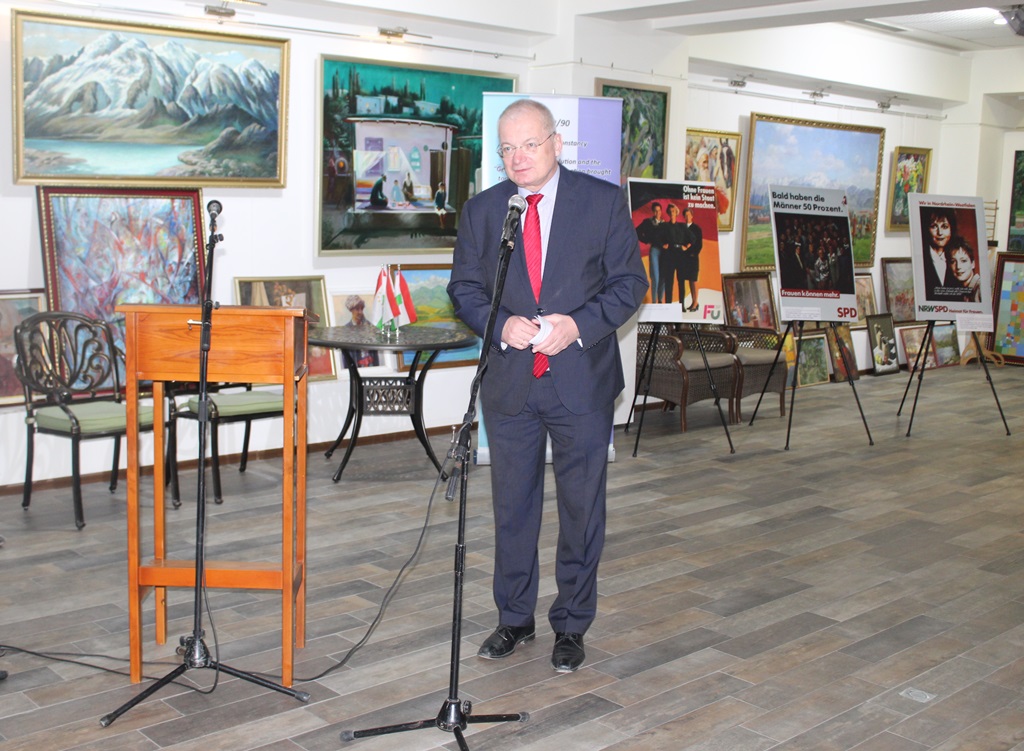
Speaking at the event, Ms. Javohir Akobirova, the head of the Department for International Cooperation under the Committee for Women and Family Affairs, in particular, noted that Tajik government’s policy is aimed a support women and involving them more in the public service.
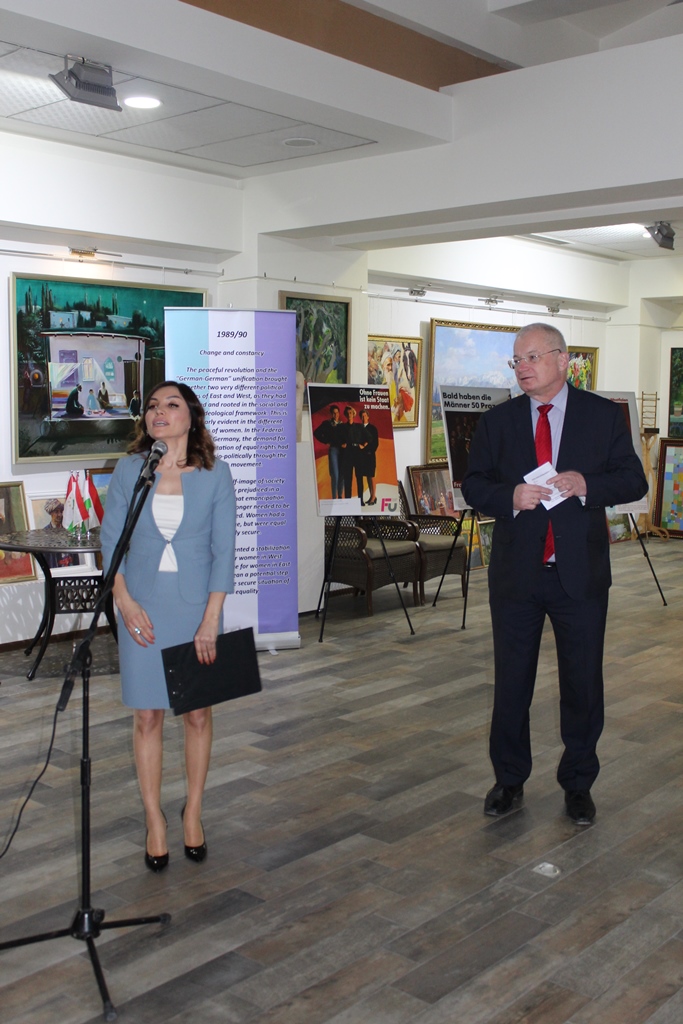
“Today, women in Tajikistan on a par with men wok in public service, hold managerial positions and make their contribution to development of society. We are glad that international organizations are sharing their experience in providing gender equality with us,” Akobirova said.
The roots of universal suffrage can be traced back to the French Revolution and its demand for equality. In March 1871, voting rights were extended to men in a revolutionary step for the German Empire. It took almost half a century for women to be granted voting rights. It was not until the first elections of the Weimar Republic in 1919, that universal suffrage was extended to include women. The Social Democratic Party and the socialists Emma Ihrer and Rosa Luxemburg were key figures for the female suffrage movement. The fight for woman’s suffrage was closely connected with the fight for female worker’s rights. Until then, women were completely excluded from elections irrespective of their age, income or rank.
During the first elections in 1919, the turnout of female voters was 1,7 % higher than of male voters. However, it took until the 1970’s until women and men had comparable turnout of voters, using their active suffrage over a longer period.
Deutschland.de reports seven – and as such almost half of the 16 positions in the Federal Cabinet are occupied by women, including those of Justice Minister and Defense Minister.
In the Bundestag the proportion of women has reportedly fallen since the 2017 federal elections, from 36 to just over 30 percent. The Greens have the highest proportion of women (who are actually in the majority within the party), accounting for 39 of the party’s total of 67 members of parliament. The same applies to The Left party, where women are slightly more strongly represented than men (37 to 32). In absolute figures, the most women in parliament belong to the Social Democrats (SPD), namely 64. The right-wing populist party AfD counts the fewest women – in both absolute figures and percent (10 of 83), followed by the liberals of the FDP (18 of 62). Women currently head the two popular parties: Angela Merkel is CDU party leader, Andrea Nahles leads the SPD.
Women's suffrage is the right of women to vote in elections; a person who advocates the extension of suffrage, particularly to women, is called a suffragist.
In 1881, the Isle of Man gave women who owned property the right to vote. In 1893, the British colony of New Zealand granted women the right to vote. The colony of South Australia did the same in 1894 and all women were able to vote in the next election, which was held in 1896. In 1899 Western Australia enacted full women's suffrage, enabling women to vote in the constitutional referendum of 31 July 1900 and the 1901 state and federal elections. In 1902 women in the remaining four colonies also acquired the right to vote and stand in federal elections after the six Australian colonies federated to become the Commonwealth of Australia. Discriminatory restrictions against Aboriginal people, including women, voting in national elections, were not completely removed until 1962.
The first European country to introduce women's suffrage was the Grand Duchy of Finland, then part of the Russian Empire, which elected the world's first women Members of Parliament in the 1907 parliamentary elections. Norway followed, granting full women's suffrage in 1913. Denmark followed in 1915, and Russian Provisional Government in 1917.[12]
Most independent countries enacted women's suffrage in the interwar era, including Canada in 1917, Britain (over 30 in 1918, over 21 in 1928), Germany, Poland in 1918, Austria and the Netherlands in 1919, and the United States in 1920 (Voting Rights Act of 1965 secured voting rights for racial minorities). Late adopters in Europe were Spain in 1933, France in 1944, Italy in 1946, Greece in 1952, San Marino in 1959, Monaco in 1962, Andorra in 1970, Switzerland in 1971 at federal level, and at local canton level between 1959 in the cantons of Vaud and Neuchâtel and 1991 in the canton of Appenzell Innerrhoden, and Liechtenstein in 1984.
The United States gave women equal voting rights in all states with the Nineteenth Amendment ratified in 1920.