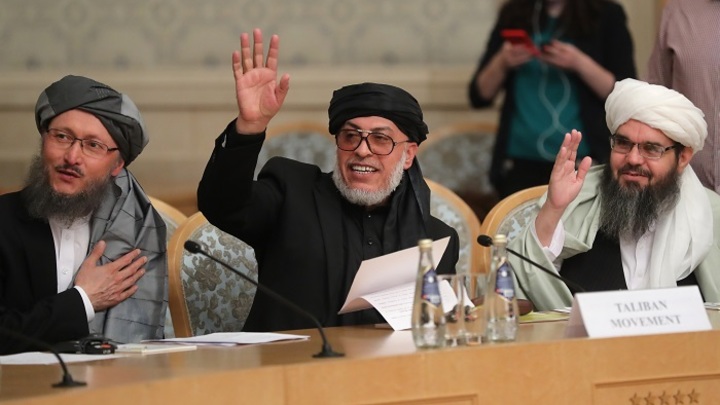
The leader of the Taliban's peace negotiations with the US says the insurgents do not want to seize "the whole country by [military] power".
“It will not bring peace to Afghanistan,” Sher Mohammad Abbas Stanikzai told the BBC on February 6.
However, he said the group would not agree to a ceasefire until foreign forces were withdrawn from Afghanistan.
UN data shows the Taliban are responsible for more civilian casualties than any other party.
Mr. Stanikzai, who until recently was the head of the Taliban's political office in Qatar and remains a leading figure in the group, was giving his first interview to the international media while attending a meeting in Moscow with senior Afghan opposition politicians.
He said the Taliban's experiences in power in the 1990s, when it faced armed opposition from rival Afghan groups, had led the group to conclude it was preferable to reach a solution by "coming to the table".
"Peace is more difficult than war," Mr. Stanikzai added, alluding to the difficulties in reaching a settlement. But he expressed hopes that the conflict could be brought to an end.
Mr. Stanikzai has overseen a series of meetings with the US special envoy for Afghan reconciliation, Zalmay Khalilzad, in recent months.
Mr. Stanikzai told the BBC he believed the Trump administration wanted to "bring peace to Afghanistan."
The meeting in Moscow is separate from the US-Taliban peace talks.
In addition to a Taliban delegation, it was also attended by former Afghan President Hamid Karzai, as well as other high-profile opposition figures.
According to Pajhwok Afghan News, presidential hopeful Mohammad Hanif Atmar on Wednesday joined senior Afghan politicians “on the second day of their unsanctioned peace talks with Taliban representatives in Moscow.”
He reportedly gave journalists a brief update about the session on Wednesday and said “we are extremely optimistic about the results.”
Topics of discussions included how the country could be governed in the future, if the Taliban were to become a mainstream political force.
TOLONews says delegates attending the peace talks in Moscow on Wednesday issued a joint declaration in which they outlined a nine point approach to promote “intra-Afghan” dialogue aimed at finding a political settlement to the conflict in the country. The declaration comes after two days of talks between some of Afghanistan’s mainstream political parties and politicians and a delegation from the Taliban office in Qatar.
The delegates unanimously agreed to hold the next round of talks in Qatar’s capital Doha as soon as possible.
The Afghan government did not participate due to the persistent refusal by the Taliban to engage in dialogue with government.
Earlier this week, Afghan President Ashraf Ghani said the Afghan politicians attending the Moscow talks have no executive authorities and are not officially representing Afghanistan. HE also questioned the mechanism of the Moscow talks.