The new investigation of Transparency International Russia (TI), which is available on the organization's website, notes that when on business trips, the Russian Minister of Industry and Trade, Denis Manturov, stays at hotels where the cost of rooms exceeds one million rubles (equivalent to US$15,500) per day.
Business trips of officials in the country and abroad are financed from the federal budget. An official can arrange a business trip in two ways: through an advance account or with the involvement of an external counterparty.
In the first case, an official is given money for travel and rent of housing, and on his return, he provides receipts and checks to the accounting department. According to TI, the Ministries of Telecommunications, Transport, Energy, Agriculture and Sports most often use this way.
The second way is carried out using the site of public procurement. It is most often used by the Presidential Administration, the Ministries of Industry and Trade, Natural Resources, Construction, Education, Culture, Economic Development and Emergencies.
Since the mid-2000s, maximum standards of living expenses for officials in business trips abroad have been introduced. They vary from country to country: in Uruguay and Fiji, this sum is $ 70 per day, while in Germany and the Netherlands – 200 euros. The standards were introduced so that officials “do not surround themselves with luxury” at the expense of the budget. At the same time, they allow staying in five-star hotels.
In 2005, federal ministers and their deputies, heads of state committees, federal services and agencies and their deputies, the General Director of the Ministry of Foreign Affairs, the Head of the Defense Ministry service and other high-ranking officials were exempted from the limits.
TI requested information on travel expenses in the Presidential Administration, the Government, the Federation Council, the State Duma, the Accounts Chamber, all federal ministries and agencies, as well as the Federal Treasury. The figures were provided only in two cases: the Ministry of Transport informed that in 2018, over 14 million rubles ($ 223.6 thousand) were allocated on hotels for secondees, and almost 60 million rubles ($ 958.4 thousand) on flights. Between 2016 and 2018, the Federal Agency for Press and Mass Communications reportedly spent 16.9 million rubles ($ 269.9 thousand) on living and travel expenses for its employees. TI was denied information in other cases.
The organization managed to get the most detailed information about the business trips of the Ministry of Industry and Trade and its Head Denis Manturov. The data turned out to be available on the website of public procurement.
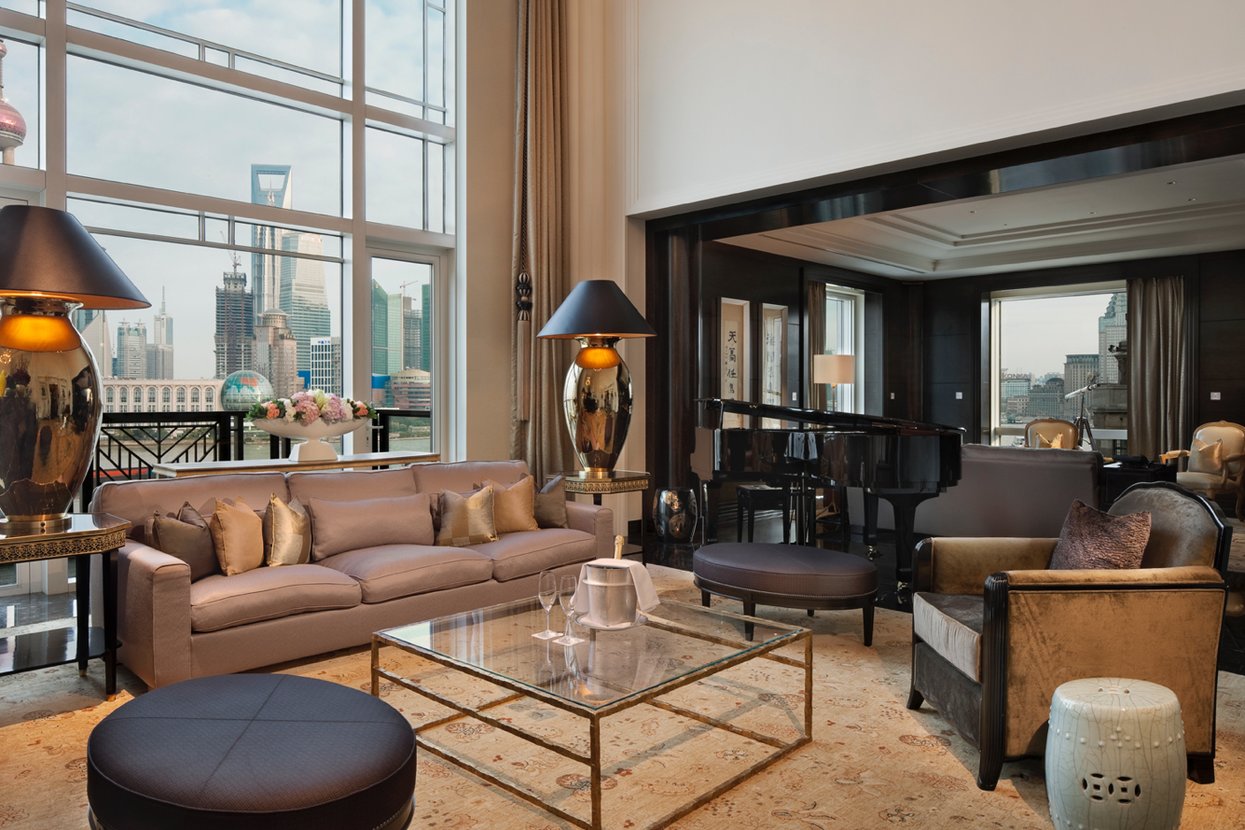
In November 2016, during a business travel to Shanghai, Manturov stayed in the presidential suite at The Peninsula Shanghai hotel worth 1.38 million rubles (equivalent to US$22,000) per day. The room size is 400 square meters. It includes a two-story dining room, a living room with a fireplace and a balcony, an office, a guest toilet, a separate dressing room with a radio, a weather panel and a nail dryer, and a marble bathroom. Guests are served a daily fruit basket and local newspaper.
In October 2017, Manturov stayed in the presidential suite of the Four Seasons Hotel Mexico City in Mexico City for 479,000 rubles (US$ 7,600) a day. In the Chinese Zhengzhou, the Minister stayed at the JW Marriott Hotel Zhengzhou for 327,000 rubles (US$5,200).
In total, between 2016 and 2017, the Ministry of Industry and Trade spent at least 19.3 million rubles (US$308,300) on staying of its employees in foreign hotels. According to TI estimates, if the Ministry staff had complied with the limits set by the government and stayed in more humble apartments, the savings would have been 12.5 million rubles (US$199,600).
The organization has sent applications on all cases of exceeding the limits to the Prosecutor General’s Office. Materials have also been sent to the Federal Treasury and the Accounts Chamber. Moreover, TI sent recommendations to the Presidential Property Management Department and the government.