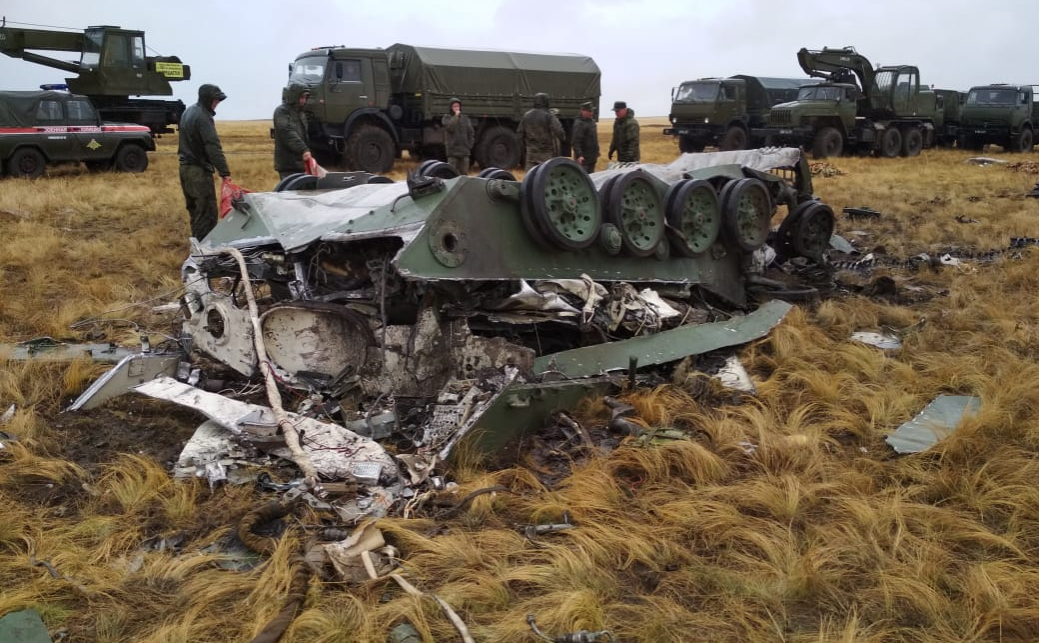
Russian media reports say two Russian airborne combat vehicles crashed to the ground when parachutes failed to open during a huge military drill, dubbed Tsentr-2019. There were no casualties as the landing was unmanned.
Two BMD-2 armored vehicles, weighing seven tons each, were utterly destroyed after plummeting from 1.524 kilometers straight into the ground after their giant, measuring nearly 350 square meters, did not open. The vehicles were launched out the back of an IL-76MD transport plane and were supposed to float to the ground on giant parachutes, but they failed to open.
The incident took place on September 20 when Russian President Vladimir Putin was overseeing the exercises.
Russia's Defense Ministry said nobody was on board the transports at the time and nobody on the ground was injured by their fall.
Forces from Russia, China, Pakistan, Kyrgyzstan, India, Kazakhstan, Tajikistan, and Uzbekistan took part in the exercises that were conducted in Russia’s Orenburg oblast from September 16 to September 21.
According to the Tajik Ministry of Defense (MoD), Tajikistan was represented by three platoons. .
The Russian Defense Ministry says the exercises involved 128,000 military personnel, more than 20,000 weapons and military equipment and about 600 aircraft.
The exercise’s scenario was based on the influence of Islamic extremism on countries in the Middle East, Southeast Asia and eventually Central Asia is growing.
A hypothetical state emerges in the southwest of Russia. Its leadership shares the extremist ideas of leaders of international terrorist organizations. From the imaginary country radical Islamism begins to spread into the territories of neighboring countries. The focus of the exercise was on ways of using the coalition’s military group for struggle against international terrorism and measures to maintain military security in Central Asia.
The exercise was conducted in two phases. The first one lasting three days was devoted to polishing the command and control of troops, measures to repel air strikes, and reconnaissance and defensive operations. In the second two-day phase a multinational group of troops carried out a massive fire strike against the hypothetical enemy.