Shavkat Mirziyoyev’s ascent in 2016 ripped Uzbekistan out of years of economic isolation. His administration has floated the sum, set in motion reforms to the tax system, improved the quality of official statistics and liberalized trade restrictions while aggressively courting neighbors. Under Mirziyoyev, Uzbekistan has emerged as one of the main drivers of reintegration in a region that has generally decentralized since the Soviet collapse.
Uzbekistan is the only Central Asian republic bordering all the others. As the most diversified economy in the region, moreover – and with the most developed manufacturing base – Uzbekistan has much to offer its neighbors. Development of the Uzbek manufacturing sector and the subsequent demand for labor could lead to an increase in migration from neighboring Kyrgyzstan and Tajikistan, further reinforcing the integration process.
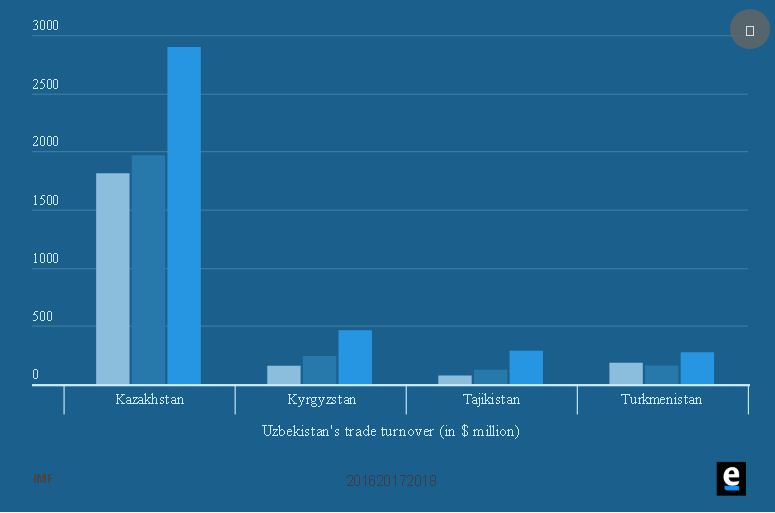
Available data, such as they are, underscore the changes. Between 2017 and 2018, Uzbekistan’s imports from Kazakhstan increased by US$569 million, or just over 53 percent.
Total trade turnover with Kyrgyzstan jumped from US$242 million to US$462 million the same year; with Turkmenistan from US$159 million to US$274 million.
A the graph below shows, trade with Tajikistan saw a particularly sharp jump (131 percent) from US$124 million to US$287 million.
This trend is continuing.
According to the latest available data from the IMF, in the first five months of 2019 Uzbekistan’s trade turnover with the other Central Asian countries totaled US$1.7 billion – 27.6 percent higher than during the same period last year.
Mirziyoyev’s predecessor, the long-ruling strongman Islam Karimov, emphasized import substitution industrialization (replacing foreign imports with domestically produced goods) as a cornerstone of economic and trade policy. Shortages resulted.
The current rhetoric is a turnaround. Mirziyoyev’s first notable economic reforms – the devaluation of the sum and the liberalization of currency controls – were a step in this direction. By easing access to foreign exchange for importers, Mirziyoyev reduced a major barrier to trade between Uzbekistan and its neighbors.