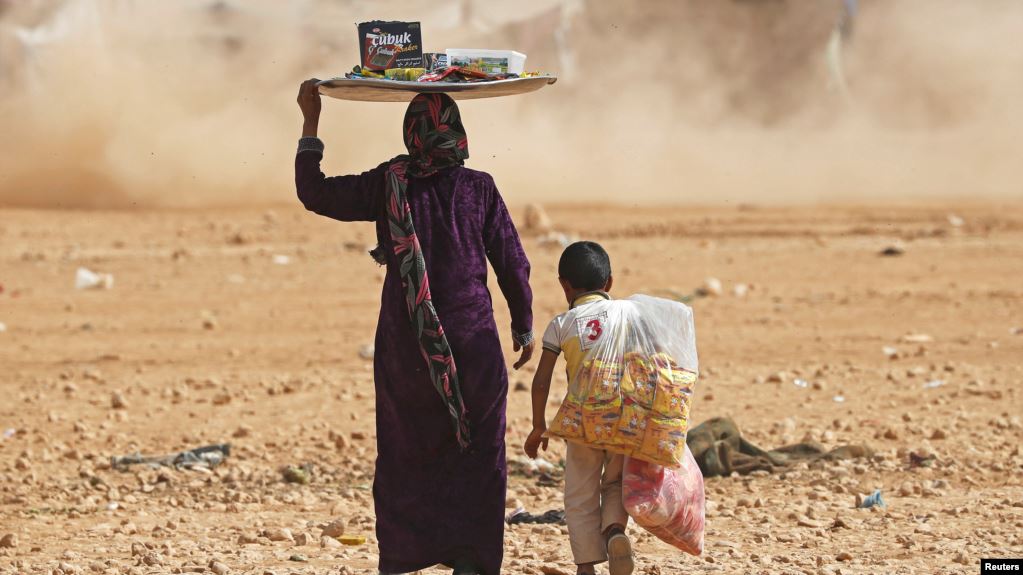
The Turkish military incursion into northern Syria has sparked "fear and panic" in displacement camps that houses thousands of women and children with suspected links to Islamic State (IS) terror group, Radio Liberty reports, citing Tajik women living there.
Gulnora Orifova, who resides in the Al-Roj camp along with her three young children told RFE/RL by phone on October 12 that food supplies were running low at the camp as nearby roads had been closed for the past four days.
"If the situation continues like this, people will starve," she said.
Maryam, another Tajik woman at the camp, told RFE/RL that Al-Roj was being rapidly cut off from everything.
Maryam, who asked that her full name not be published, said she and her two young children depended on money wired from her relatives in Tajikistan to buy food.
But even money transfers were now impossible, she said. "All vital routes are closed now and food supplies are finishing too."
The Al-Roj camp reportedly houses nearly 2,000 women and children who allegedly had links to IS. Among them are some 30 Tajik nationals, including several infants.
Al-Roj is inside the 30-kilometer “safe zone” Turkey wants to create in Syria as its forces continue their attack, which began on October 9.
Amid the Turkish assault, Kurdish officials have said they cannot guarantee the security of the camps they guard.
The Kurds say they separately hold more than 12,000 suspected IS fighters, including foreign nationals, in makeshift prisons.
The largest of the camps is Al-Hawl, home to some 60,000 women and children with links to IS and some 10,000 other civilians displaced by the conflict.
According to RFE/RL, Authorities in Dushanbe estimate there are some 400 Tajik citizens, including many children, in Al-Hawl.
A Tajik woman who gave her first name as Farishta, told RFE/RL that the Turkish assault had triggered chaos and a humanitarian crisis at the camp.
The Turkish invasion has reportedly prompted Tajikistan to postpone a planned trip to northeast Syria by a Tajik diplomat in the coming weeks to begin the repatriation of the Tajik citizens in the camps.
Tajikistan’s Ambassador to Iraq and Kuwait, Zubaidullo Zubaidzoda, who is in charge of the operation to return the Tajiks who are stranded in Syria and Iraq, told RFE/RL on October 12 that he won't be traveling to the area until after the clashes between Turkish forces and the Kurds are finished.
Recall, Tajik authorities intend to bring back home women and children stranded in Syrian refugee camps. According to some sources, Syrian refugee camps currently house at least 575 Tajik women and children whose families had joined the Islamic State (IS) terror group. Most of the Tajiks are reportedly in the Al-Hawl refugee camp, located in northeastern Syria.