Nine athletes are representing Tajikistan at the 2019 World Sambo Championships that a taking place in Cheongju, South Korea.
Akmaliddin Karimov (-57kg), Khoushqadam Khusravov (-62kg), Parviz Dodov (-68kg), Mirzojalil Ramazonov (-74kg), Zafar Olimshoyev (-90kg), and Odiljon Safarov (+100rg) in the sport sambo competitions, while Sorbon Latipov (-62kg), Jamshed Umarov (-57kg), and Khudoyor Rajabzoda (+68kg) will participate in the combat sambo competitions.
World champion Khoushqadam Khusravov says he is ready to defend his title.
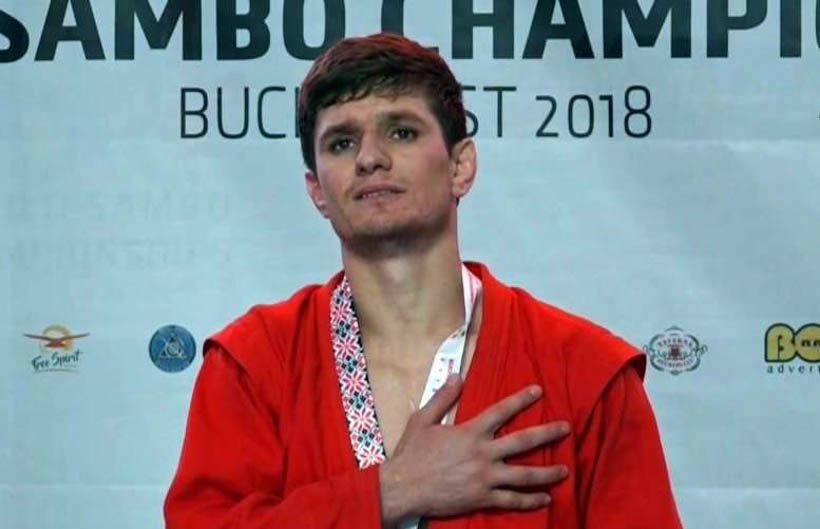
Recall, Khoushqadam Khusravov won the gold medal for Tajikistan last year in the 2018 World Sambo Championships in Bucharest, Romania, finishing first in -62kg weight category. In the final he defeated Russian athlete Russian Bagdasaryan.
In all, some 1,500 athletes from 105 countries of the world are competing for medals at the 2019 World Sambo Championships.
The World Sambo Championships are the main championships in Sambo and Combat Sambo.
Organized by the Fédération Internationale de Sambo (FIAS), this year’s World Sambo Championships is taking place in Cheongju, South Korea from November 8 to November 10.
Sambo is a Soviet martial art and combat sport. It originated in the Russian SFSR in Soviet Union. The word "SAMBO" is a portmanteau for samozashchita bez oruzhiya, which literally translates as "self-defense without weapons." Sambo is relatively modern, since its development began in the early 1920s by the Soviet NKVD and Red Army to improve hand-to-hand combat abilities of the servicemen. It was intended to be a merger of the most effective techniques of other martial arts.
Sport sambo is stylistically similar to old time catch wrestling and judo, and in a lot of ways influenced by them, but with some differences in rules, protocol, and uniform. More akin to catch wrestling, and in contrast with judo, sambo allows various types of leg locks, while not allowing chokeholds. It also focuses on throwing, ground work and submissions, with very few restrictions on gripping and holds.
Utilized and developed for the military, combat sambo resembles modern mixed martial arts, including forms of striking and grappling. Combat sambo allows regular punches, kicks, elbows and knees, as well as soccer kicks, headbutts and groin strikes, in addition to throws, holds, chokes and locks, except for a standing or flying wristbar.
Combat sambo is designed to tackle certain tasks. The effectiveness of this martial art determined by its structure, namely by three components: boxing, sambo and adapters. The task of adapters is to ensure the safe transition from middle distance to close one, as well as the consistent usage of sambo and boxing techniques. The given configuration provides the fusion of two types of martial arts into a single system.