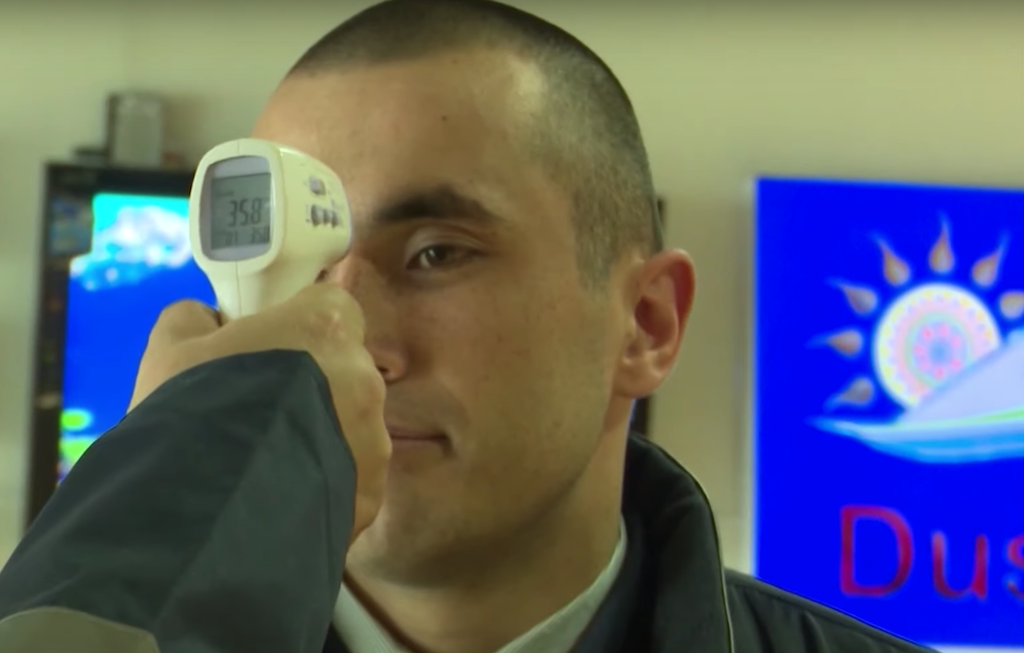
Eurasianet says a group of Chinese diplomats was last week held at Tajikistan’s main international airport for up to 18 hours after they declined to submit to quarantine procedures intended to stem the spread of the coronavirus.
Prague-based website Akhbor reported on February 9 that the impasse was only resolved after the Foreign Ministry and the Chinese Embassy in Dushanbe got involved.
Tajik health authorities have stepped up preventative measures in recent weeks as part of their efforts to contain a global epidemic. World Health Organization (WHO) director-general Tedros Adhanom Ghebreyesu has described coronavirus as a “very grave threat for the rest of the world.”
The Tajik Health Ministry requires anybody traveling from China to remain in quarantine for a period of 14 days. There are quarantine centers in all the country’s regions and they are currently holding a total of around 400 people. There have been no confirmed cases of the illness in Tajikistan.
These kinds of policies have generated approval from the public, who have hailed officials for sticking to their line even in the case of Chinese diplomats.
“I am glad that the Tajik authorities insisted on their position that the diplomats should have to go through quarantine,” Bakhtiyor Safarov commented on his Facebook page.
Beijing is fast emerging as Tajikistan’s most important economic partner, and it could have been expected that Dushanbe might make concessions to avoid provoking offense, according to Eurasianet. Tajik authorities have reportedly made some accommodations by reserving a separate facility, in the scenic Varzob gorge, just outside Dushanbe, to accommodate diplomatic personnel needing to submit to quarantine procedures.
The coronavirus epidemic may not have claimed any victims in Tajikistan, but it is spreading anxiety, as it has elsewhere in the region. Many people in Dushanbe have taken to wearing surgical masks, which have gone up in price from the equivalent of $0.05 (0.5 somoni) to $0.20 (2.00 somoni) since the outbreak first hit international headlines. Many pharmacies have run out of supplies.
Authorities have said that in the interests of security, they have temporarily halted the delivery of food goods from China. Flights between the countries have been suspended since January 23.