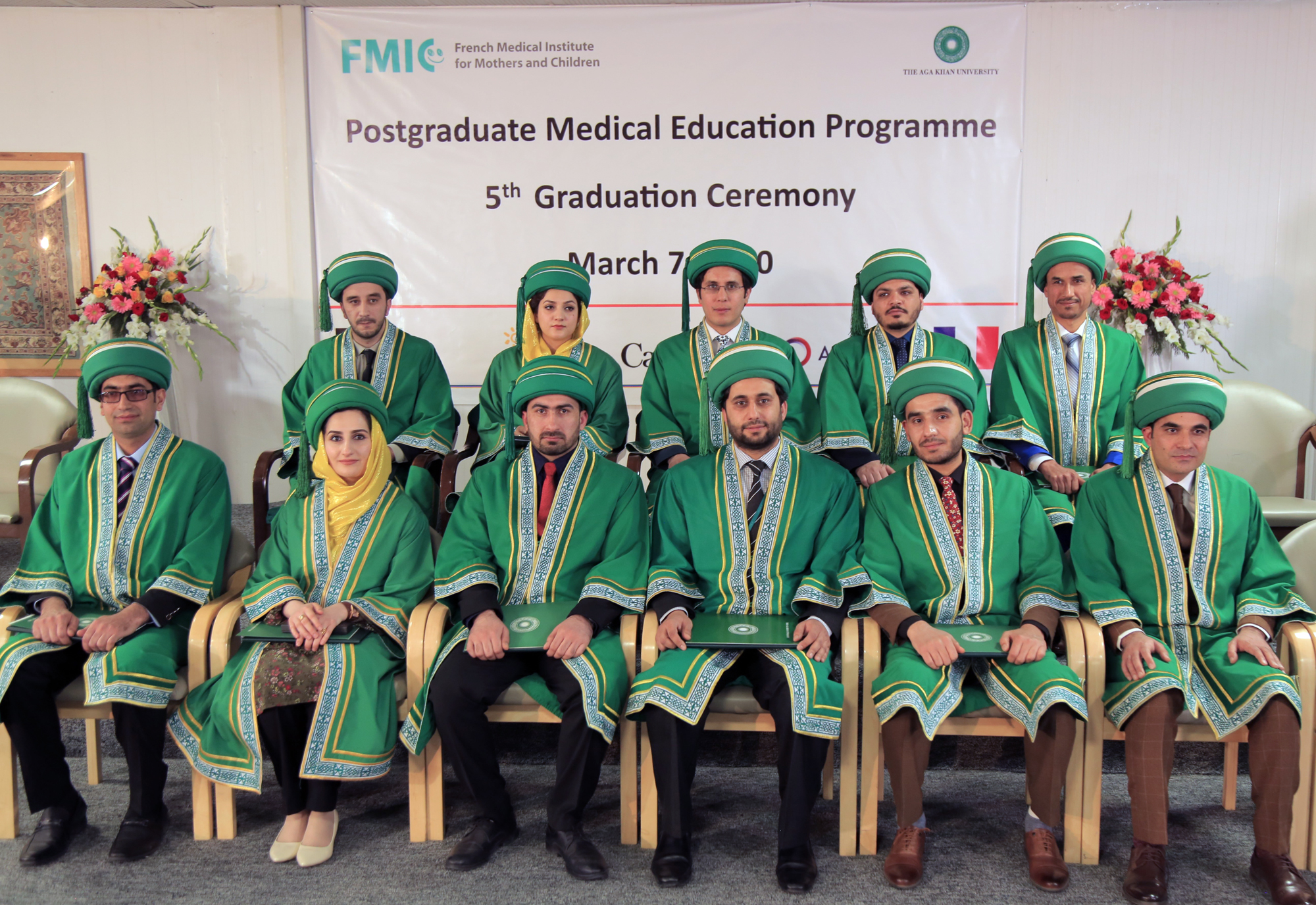
To meet the critical needs for medical specialists in Afghanistan in fields such as pediatrics and cardiology, the French Medical Institute for Mothers and Children (FMIC) graduated twelve specialists, according to the Aga Khan Development Network (AKDN).
Ten male and two female doctors were reportedly awarded certificates in seven specializations, including Anesthesia, Radiology, Orthopedics, Pediatric Surgery, Pathology, Pediatric Medicine and Cardiology.
The certificates were awarded by Dr. Ahmad Jan Naeem, Advisor to the Minister of Public Health, Afghanistan, and Dr Shafiq Mirzazada, Director, Academic Projects in Afghanistan, Aga Khan University (AKU-APA).
FMIC’s Post-Graduate Medical Education (PGME) flagship program was developed in partnership with the Aga Khan University and Ministry of Public Health.
Ambassador Sheherazade Hirji, AKDN Diplomatic Representative to Afghanistan, said “the PGME program brings cutting-edge skills and knowledge in Afghanistan while training doctors in rare specialties, promoting clinical practices and evolving research based inquiry in medicine”.
Dr. Ahmad Jan Naeem praised the efforts of the graduating doctors with the hope that those doctors will serve the people of Afghanistan to the best of their abilities. He also applauded FMIC’s contribution in i
The French Medical Institute for Mothers and Children (FMIC) is a non-governmental tertiary teaching hospital established in 2006 as the product of a unique four-way partnership between the Governments of the Islamic Republic of Afghanistan and France, and two private, international development organizations – La Chaîne de l’Espoir (CDE) and Aga Khan Development Network (AKDN).
FMIC started its operations in a volatile situation when security conditions were deteriorating and accessing a modest tertiary healthcare facility was a tall order for the Afghans. A serious lack of human resources in various specialties forced many Afghans to go abroad. For the last 14 years, FMIC has sought to expand the specialties available to Afghanistan by being “a leading institute of excellence and innovation in healthcare, research and education, providing exemplary, safe, comprehensive, accessible and sustainable services to Afghanistan and surrounding regions, while positively impacting the lives of patients and all others whom it serves”.
Founded by His Highness the Aga Khan, the Aga Khan Development Network (AKDN) is a group of private, international, non-denominational agencies working to improve living conditions and opportunities for people in specific regions of the developing world. The Network’s organizations have individual mandates that range from healthcare (through over 400 health facilities including 13 hospitals) and education (with over 200 schools) to architecture, rural development, the built environment and the promotion of private-sector enterprise. Together, they work towards a common goal – to build institutions and programs that can respond to the challenges of social, economic and cultural change on an on-going basis. AKDN works in 30 countries around the world, employing approximately 96,000 people, the majority of whom are based in developing countries. The AKDN’s annual budget for non-profit development is approximately US$ 1 billion. AKDN agencies conduct their programmes without regard to faith, origin or gender.