World Bank’s report says the COVID-19 pandemic had a significantly adverse impact on Tajikistan's economy and created major social and health sector pressures. Restrictions on labor mobility and economic activity at home and abroad have reportedly resulted in lower migrant remittances, weaker consumer demand, and reduced investments.
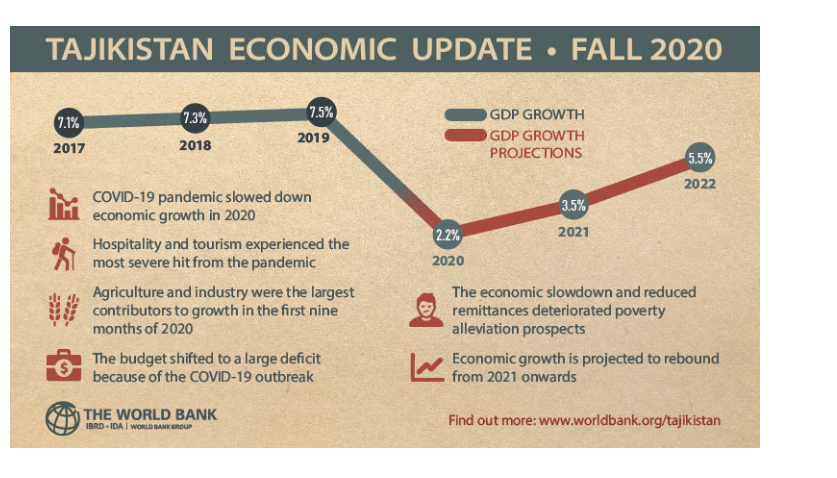
Tajikistan Economic Update – Fall 2020, in particular, notes that real GDP growth slowed to 4.2 percent year-on-year in the first nine months of 2020, compared to 7.2 percent a year earlier.
Although exports have enjoyed a record global demand for gold, the domestic market reportedly collapsed, suggesting a more severe impact of COVID-19 on domestic jobs and incomes. A growing share of the population have reported reducing their food consumption, and the inability of previously returned migrants to travel abroad led to a significant increase in the unemployment rate.
The healthcare system faces unprecedented pressure to accommodate a sudden influx of patients, according to the report. International financial institutions and partner countries have rushed with financial and in-kind aid to help Tajikistan contain the pandemic’s impact.
In an effort to ameliorate the economic fallout, the authorities deferred tax collections, boosted health and social spending, and eased monetary policy. They established an interagency task force to address health challenges emerging from the pandemic. The government amended the 2020 state budget, substantially increased healthcare expenditure, and expanded social assistance transfers to the population. Deferred tax payments and postponement of the administrative price increases provided liquidity support to firms and households.
In 2020, a growing share of the population is projected to fall into poverty.
Despite lower revenues, the government reportedly managed to consolidate the state budget by scaling up spending cuts in the maintenance and repair works, purchasing new equipment, and deferring low-priority projects. Because of higher spending on healthcare and social assistance programs, the amended 2020 state budget targets a fiscal deficit of 5.8% in 2020.
The Tax Committee reported that the agency could collect only 53% of the large taxpayers’ collection targets. In the first nine months of 2020, the government received TJS 515 million in budget support grants, which helped offset the shortfall in tax revenues.
The country’s external public debt reportedly reached almost 40% of GDP by September 2020 compared to 36.6% of GDP at the end of 2019.
The economy is expected to gradually bounce back in 2021-22, assuming the availability and distribution of a vaccine, and a restoration of remittances inflows and international trade. Inflationary and exchange rate pressures are projected to moderate as import prices subside and foreign exchange inflows edge up.
With support from development partners, the government is expected to continue shoring up healthcare and social protection systems. On the downside, intensification of the pandemic and prolonged restrictive measures would diminish growth prospects. High dependence on commodity exports and remittances magnifies exposure to external risks. Domestic risks primarily reflect limited fiscal space, inefficient state-owned-enterprises, and challenges in the business environment.
After a sharp decline in April and May 2020, the labor market began quickly recovering from June to August in the absence of lockdown measures. In August, the number of job vacancies posted online recovered to pre-crisis level. However, severe vulnerabilities remain. Among those reporting continued work disruptions, a rising share believe that job losses may be permanent.
Food insecurity remains seriously elevated, and far above 2019 levels, according to the report.