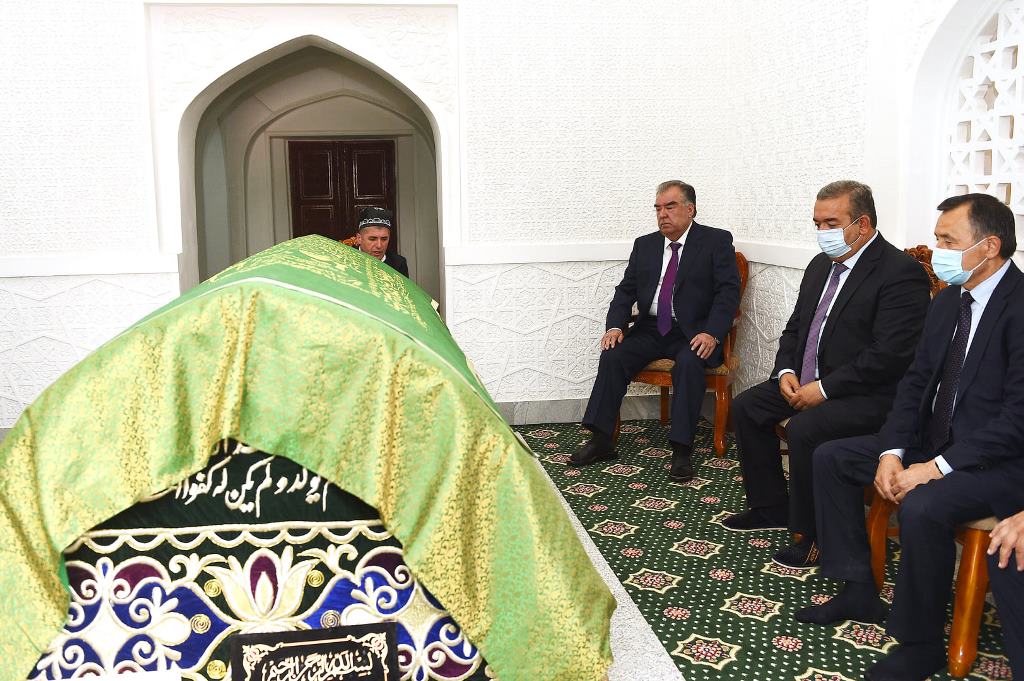
President Emomali Rahmon yesterday began his working visit to Kulob from visiting the tomb of Mir Sayyid Ali Hamadani.
Emomali Rahmon read the verses from the Holy Quran and dua for the well-being of the people and country at the Mir Sayyid Ali Hamadani tomb, according to the Tajik president’s official website.
The head of state then visited places affected by mudflows and got acquainted with the pace of the work to eliminate the consequences of the natural disaster.
Between May 6 and May 13, Tajikistan experienced incessant torrential rains, triggering floods, landslides and mudflows in many parts of the country’s southwest. The subsequent floods and landslides affected more than 25,000 people and damaged close to 1,000 houses, some of which completely destroyed. As a result, communities have lost their food supplies, personal assets, as well as livestock and agricultural lands, which are the main sources of livelihood in this predominantly agricultural country. Khatlon was among the worst affected regions.
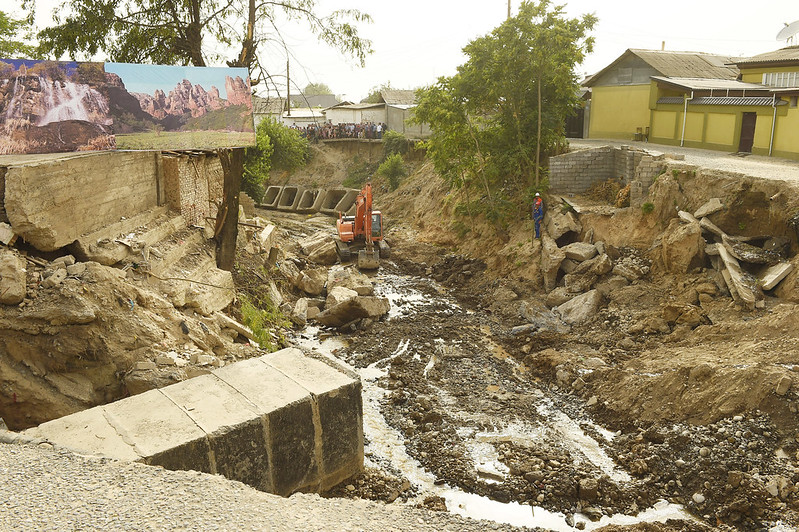
In Kulob, mudflows reportedly destroyed completely 43 houses and partially damaged 102 houses. The mudflows also damaged 10 bridges, 4 schools and kindergartens, 6 kilometers of roads, more than 13 irrigation canals, 128 ares of arable lands, seven substations and five electrical units. Damage caused by mudflows to Kulob has been estimated at 45.5 million somonis.
Today, Rahmon left Kulob for Danghara, where he will inaugurate a number of social and industrial facilities.
Mir Sayyid Ali Hamadani (1314–1384) was an Iranian scholar, poet and a Sufi Muslim saint of the Kubrawiya order. He was born in Hamadan, Iran and preached Islam in Central and South Asia as he travelled to practice Sufism. He died in Khatlon, Tajikistan in 1384 CE, aged 69–70. Hamadani was also addressed honorifically throughout his life as the Shāh-e-Hamadān ("King of Hamadan"), Amīr-i Kabīr ("the Great Commander"), and Ali Sani ("second Ali").