Khaama Press news agency reported on August 30 that the supreme leader of the Islamic Emirate of Afghanistan (IEA) Mullah Hebtullah Akhund arrived from an unknown place in Afghanistan’s Kandahar province on Sunday, August 29.
He has reportedly met with tribal leaders of Kandahar province and the IEA is due to release a statement on his behalf.
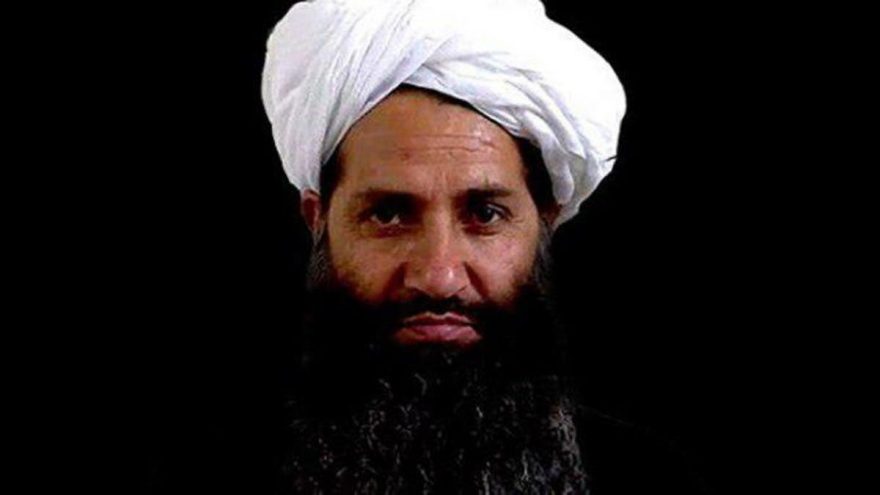
The supreme leader of whom the world has only a single photo is due to come to the Afghan capital and hold a series of talks with other Taliban officials and other Afghan politicians and leaders.
Prior to that, Mullah Abdulghani Baradar the co-founder of Taliban and head of Taliban’s political office in Doha had also landed in Kandahar province who then came to Kabul along with the delegation.
The Taliban’s governance is said to be commenced from Kandahar province.
Negotiations over the upcoming government in Afghanistan are expected to be expedited after the supreme leader arrives in Kabul.
Earlier, the acting minister of information and culture and spokesperson of the Taliban Zabiullah Mujahid had said that their cabinet to take shape in the upcoming two weeks.
The Taliban though has not said anything about the form of upcoming government, acknowledged that the government will be led by religious scholars (Ulamas).
Hebtullah Akhundzada (born 1961) is an Afghan religious leader who is the third supreme leader of the Taliban and the Islamic Emirate of Afghanistan. The Taliban call him the Amir al-Mu'minin (Commander of the Faithful), which was the title of his two predecessors. He is also known by the honorifics Mawlawi and Mullah.
Akhundzada is well-known for his fatwas on Taliban's matters. He served as the head of the Sharia courts of the Islamic Emirate of Afghanistan. Unlike many Taliban leaders, he has no military experience. He was elected as the leader of the Taliban in May 2016, following the death of the previous leader, Akhtar Mansour, in a drone strike.