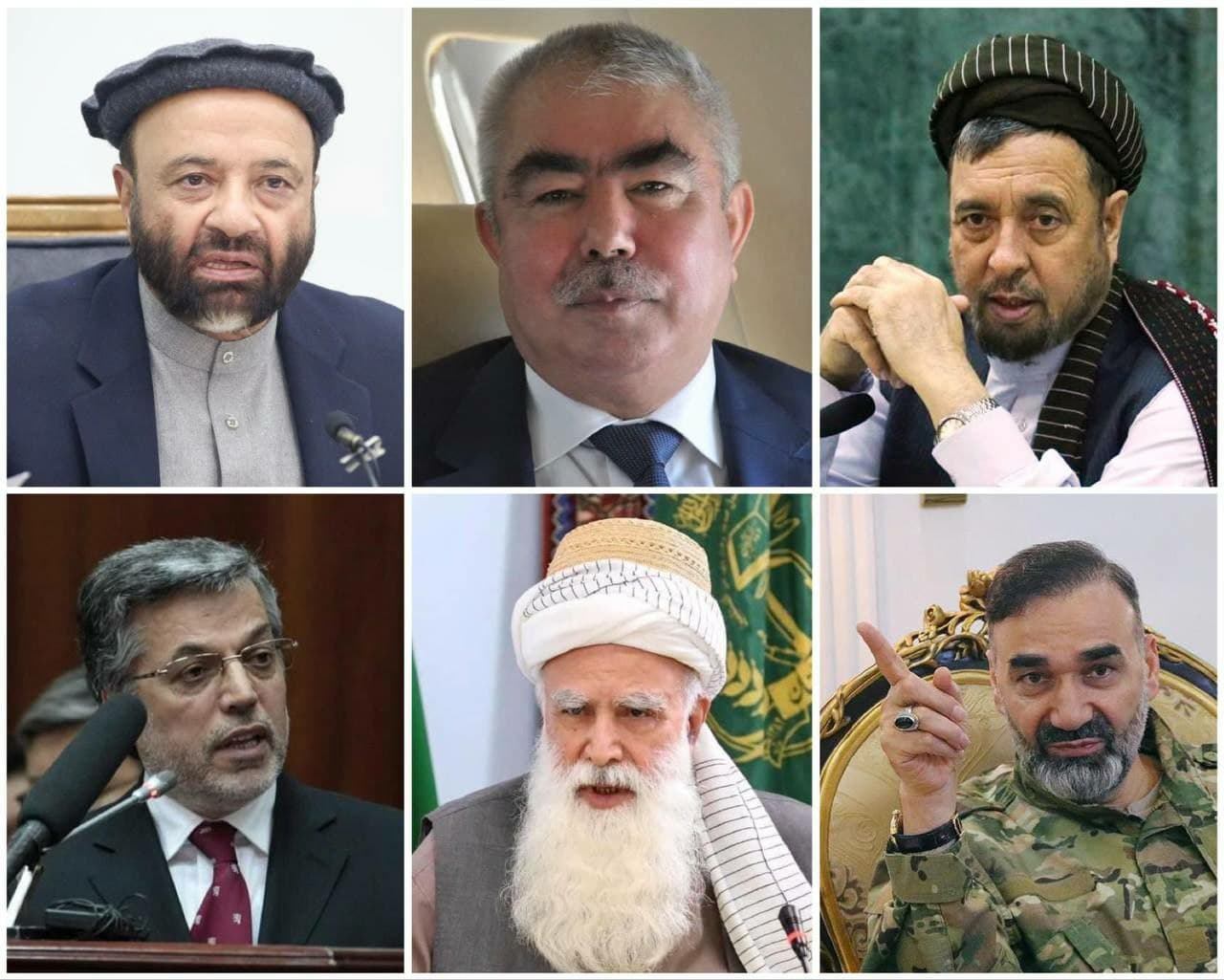
Some Afghan political figures announced the formation of a coalition called the “Supreme Council of National Resistance of the Islamic Republic of Afghanistan.” The council’s headquarters have not yet been announced, but those who appear to be members of the council are currently living abroad.
Hasht-e Subh reports that in a statement released October 22, the Council outlined its agendas in two parts: 1) a political agenda that seeks to achieve a just peace through negotiation; and 2) a “military-defense” agenda in which the members are likely to take up arms.
“The Front has two main political and military missions,” said the statement. “Undoubtedly, our preference is to achieve lasting peace through politics.”
The statement did not comment on the members of the Supreme Council of Resistance. But Abdul Rab al-Rasoul Sayyaf, Mohammad Mohaqiq, Atta Mohammad Noor, Marshal Abdul Rashid Dostum, and some other political figures are said to be members. The preamble to the declaration states that a group of “prominent and sympathetic” political parties and figures have established a front called the “Supreme Council of the National Resistance of the Islamic Republic of Afghanistan” to get rid of this situation, Hasht-e Subh said, noting that Mohammad Karimi Khalili, the leader of the Islamic Unity Party, has rejected his membership in the Council.
The statement says Afghanistan is in turmoil due to incompetence, dictatorship, monopoly and widespread corruption, adding that the government had disintegrated as a result of a “cowardly, treacherous and deceptive deal”.
The statement added that security, service and administrative institutions all fell because of this. Now that the nation is facing poverty, misery, insecurity and various problems, it is also for the reasons mentioned above.
The Front has also said that it is trying to resolve the country’s issues through politics, and therefore negotiations are extremely important.
The Council called on the people to prepare for a “difficult and long-term resistance” to end “an internal tyranny, aggression and foreign occupation.”
The coalition has called on the United Nations and the international community to end the “unilateral, authoritarian and anti-national unity” government of the Taliban, which ignores ethnicities, women, religions and official languages, stressing that half of its members are under UN sanctions and some other countries.
The Council has also called on the international community and aid agencies to provide direct humanitarian assistance to the people of Afghanistan.
The Supreme Council of Resistance has warned that if the other side (the Taliban) is not convinced of a political solution, the Front will inevitably choose the second option (military action) and that the Taliban will be responsible for its consequences.
Meanwhile, Pajhwok says that some politicians have dismissed as untrue the creation of a “National Resistance Council” in Turkey as being circulated in social media, particularly Facebook.