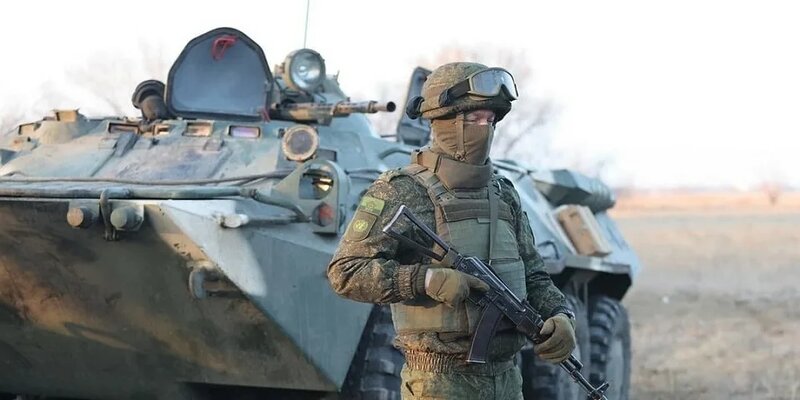
Peacekeepers of the Collective Security Treaty Organization (CSTO) are set to withdraw from Kazakhstan.
Kazakh President Kassym-Jomart Tokayev today presented parliament with a new Cabinet that will be tasked specifically with addressing serious social and economic problems.
Tokayev nominated Alikhan Smailov for Prime Minister, and the lower house of parliament swiftly voted him in during a session broadcast live on state television.
The 49-year-old Smailov previously served as Kazakhstan’s finance minister from 2018 to 2020. In 2019, he became the first deputy prime minister in the Cabinet which was dismissed by President Kassym-Jomart Tokayev during last week’s violent protests in the country that began over spiraling fuel prices.
Tokayev told the parliament that CSTO peacekeepers are also set to withdraw from Kazakhstan.
“The main mission of the CSTO (Collective Security Treaty Organization) troops has been successfully completed, and the phased withdraw of the CSTO joint peacekeeping contingent will begin in two days” he was cited as saying by RIA Novosti.
According to him, the withdrawal process will take not more than ten days.
Recall, Kazakh President Kassym-Jomart Tokayev on January 5 appealed to the CSTO for assistance dealing with what he called a “terrorist threat” and the CSTO agreed to send peacekeepers the first time in the organization’s 30-year history.
The CSTO began deploying its peacekeepers in Kazakhstan on January 6 to guard strategic facilities in the country.
Article 4 of the Collective Security Treaty states that: “In the case of aggression (an armed attack threatening safety, stability, territorial integrity and sovereignty) against any Member States, all other Member States at request of this Member State shall immediately provide the latter with the necessary aid, including military.”
This is the first time that the CSTO has agreed to deploy military forces to support an ally. It has refused requests on at least two other occasions: from Kyrgyzstan, during massive ethnic unrest in 2010; and from Armenia in 2021, as Azerbaijan pushed its post-war advantage by carrying out military incursions into Armenian territory.
On October 6, 2007, CSTO members agreed to a major expansion of the organization to create a CSTO peacekeeping force that could be deployed under a U.N. mandate or without one in its member states.
On December 10, 2010, the member states approved a declaration establishing a CSTO peacekeeping force and a declaration of the CSTO member states, in addition to signing a package of joint documents.
Created in 1992, the Collective Security Treaty Organization is a Russia-led military alliance grouping the six former Soviet republics of Armenia, Belarus, Kazakhstan, Kyrgyzstan, Russia and Tajikistan.