The Eurasian Development Bank (EDB) has surveyed the Eurasian Economic Union (EAEU) and Tajikistan’s companies to find out how they assess integration and economic cooperation.
The Bank has published survey results as part of the EDB Integration Business Barometer project. Most companies reportedly feel positive about the Eurasian integration. The most welcome measures adopted in the EAEU are digital transformation, in particular, the one stop shop system.
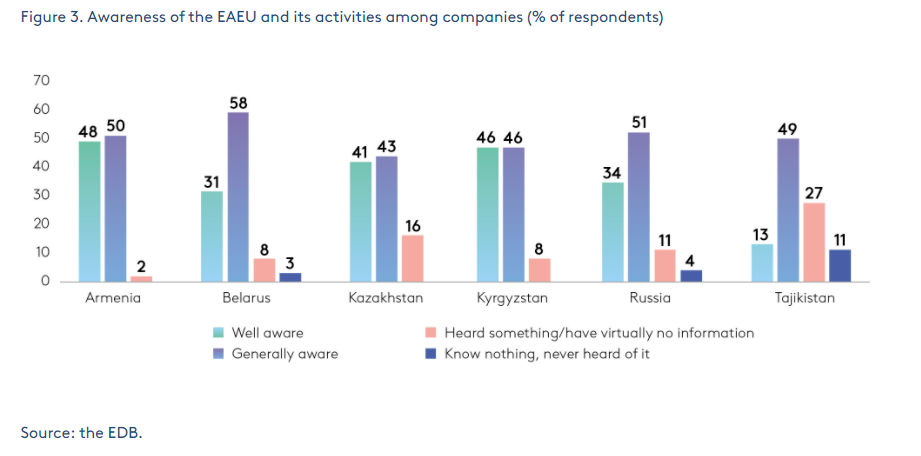
The survey has reportedly found that awareness of the EAEU among companies in the six countries averages 85%. The highest levels of awareness are in Armenia and Kyrgyzstan (where 98% and 92% of those surveyed, respectively, answered they were “well aware” or “generally aware” of the EAEU), as well as in Kazakhstan (84%). Companies in Russia and Belarus have almost the same level of awareness of the EAEU and its activity – a third of the companies surveyed are well aware and just over a half are generally aware of the Union.
Tajikistan, which is not a member of the Union, has the lowest awareness among companies – a third of respondents are poorly aware of the EAEU, while another 11% said that they had never heard of it before.
However, large and medium-sized companies in Tajikistan are interested in learning about the opportunities the EAEU offers. They reportedly expect the EAEU to provide financial support, promote cooperation, eliminate customs barriers, simplify administrative and tax procedures, expand exports and imports, and facilitate access to new markets.
As it had reported earlier, EDB’s analysts in 2020 assessed the economic effects of Tajikistan’s possible accession to the EAEU. According to them, the main advantages of the country’s possible joining the EAEU are expected to materialize in three areas: realization of the advantages of the common labor market, the EAEU; and development of the country’s trade and investment potential. The authors estimate that the annual growth rate of the nation’s economy may increase by up to 3 percentage points.
An analytical report, Economic Effects of Tajikistan's Accession to the Eurasian Economic Union, released by EDB on November 23, 2020 in particular, notes that the high level of current trade integration with EAEU countries is one of the key prerequisites for Tajikistan’s accession to the Union.
Should the country join the Eurasian Economic Union, the EDB estimates that not only remittances can be expected to grow, but also the wages of migrants – by an average of 10-30%. All these changes may stimulate additional accumulated remittances of US$1.3-1.5 billion within five years of the country’s joining the Union.
According to the report, Tajikistan’s accession to the Eurasian Economic Union may also be conducive in the medium term to simplifying the rules of doing business, and to creating more favorable conditions for attracting direct investments.
The report says institutional improvements are a priority that can offset the costs of Tajikistan’s accession to the EAEU and ensure the realization of the trade and investment potential of cooperation.
In spite of the mentioned significant benefits, the Tajikistan’s possible accession to the EAEU is also associated with some short-term costs. Potential disadvantages include a possible reduction in trade turnover with third countries, the risk of losing sources of financing for economic development, as well as challenges associated with bringing the national legal framework in line with Union requirements.