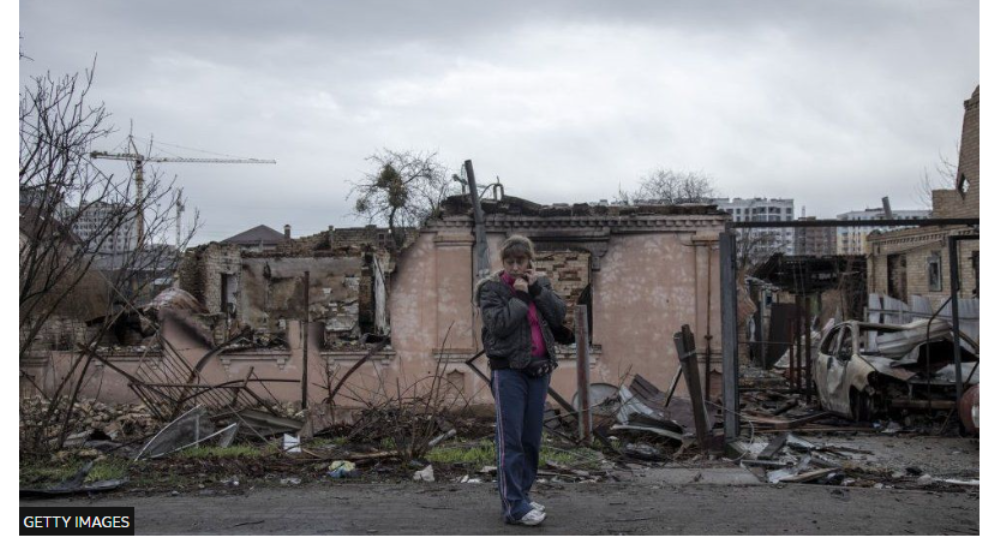
NATO ministers have been meeting in Brussels this past week to discuss how far they should go in providing military equipment to Ukraine, BBC security correspondent Frank Gardner noted on April 10.
The challenge for NATO throughout this war has been how to give its ally Ukraine enough military support to defend itself without getting drawn into the conflict and finding itself at war with Russia.
The Ukrainian government has reportedly been explicit in its calls for help.
Ukraine reportedly wants tanks, warplanes, drones and advanced missile air defense systems to counter Russia's increasing use of air strikes and long-range missiles that are steadily depleting Ukraine's strategic stores of fuel and other essentials.
The risk of Russia resorting to using tactical (ie short range) nuclear weapons or of the conflict spreading beyond Ukraine's borders into a wider European war is constantly in the backs of western leaders' minds and here the stakes are dangerously high, according to the BBC.
Over 30 Western countries have reportedly provided military aid to Ukraine including €1bn from EU and US$1.7bn from US. Supplies so far limited to arms, ammunition, and defensive equipment like anti-tank and anti-aircraft missile systems: they include Javelins which are shoulder-held anti-tank weapons that shoot heat-seeking rockets, Stingers, man-portable anti-aircraft weapons; and Starstreak, a UK-made portable air defense system.
NATO members reportedly fear supplying heavier offensive equipment like tanks and fighter jets could lead to direct open conflict with Russia. That, however, has not prevented the Czech Republic from giving T72 tanks
President Putin reminded the world early on in this war that Russia is a nuclear weapons power and that he was moving its strategic nuclear deterrent up to a higher degree of readiness.
The US did not follow suit as it detected no movement of Russian nuclear warheads out of their secure storage bunkers, but Putin's point was made, according to the BBC.
Russian military doctrine reportedly allows for the early use of low-yield, tactical nuclear warheads on the battlefield, knowing that the West has abhorrence for nuclear weapons that have not been used in anger for 77 years.
NATO strategic planners reportedly worry that once the nuclear taboo is broken, even if the damage is limited to a localized target on the Ukrainian battlefield, then the risk of escalation to a catastrophic nuclear exchange between Russia and the West inevitably goes up a notch.
Tobias Ellwood MP, who chairs Parliament's Defense Committee, is reportedly one of those who believes Putin is bluffing when he raises the specter of nuclear weapons and that NATO should be doing more.
According to the BBC, there are number of potential scenarios, which will doubtless be occupying minds in Western defense ministries.
Here are just three of them:
1. A NATO-supplied anti-ship missile fired by Ukrainian forces in Odesa hits and sinks a Russian warship offshore in the Black Sea with the loss of nearly 100 sailors and dozens of marines. A death toll of this magnitude in a single strike would be unprecedented and Putin would be under pressure to respond in some form.
2. A Russian strategic missile strike targets a supply convoy of military hardware crossing from a NATO country, like Poland or Slovakia, into Ukraine. If casualties were sustained on NATO's side of the border that could potentially trigger Article 5 of NATO's constitution, bringing the entire alliance to the defense of the country attacked.
3. Amidst fierce fighting in the Donbas an explosion occurs at an industrial facility resulting in the release of toxic chemical gases. While this has already occurred, there were no deaths reported. But were it to result in the sort of mass casualties seen in Syria's use of poison gas at Ghouta and if it were found to have been deliberately caused by Russian forces, then NATO would be obliged to respond.
It is perfectly possible that none of these scenarios will materialize, BBC security correspondent added.