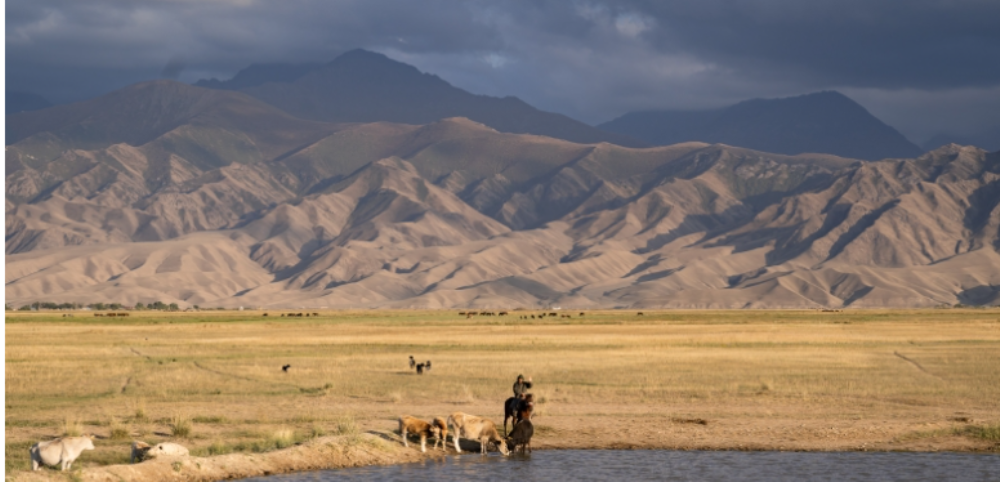
For farmers in Kyrgyzstan, keeping livestock is a vital source of income. Over the last 20 years, the cattle population in the country has reportedly increased by 60 percent.
While this has improved the socioeconomic standing of farmers and their families, the sharp growth has also contributed to the degradation of pastures, impacting their sustainability, according to the Aga Khan Development Network (AKDN).
The number of livestock is growing every year and there are not enough pastures to accommodate them. Many pastures have degraded due to overgrazing. If farmers do not start to focus more on the quality of livestock rather than its quantity, they face the risk of losing their pastures.
With funding from the Government of Switzerland, the Aga Khan Foundation (AKF) and Helvetas Swiss Intercooperation have been working with agricultural communities in the Alai and Chon-Alai regions of the Kyrgyzstan through the Bai-Alai project to help farmers transition to breeding fewer, high-quality cows. The project provides access to natural and artificial insemination services. These enable farmers to produce half-breed cows, which have a higher monetary value and can produce more milk than local
According to data collected by the Bai-Alai project, half-breed calves weigh on average 90 kg more than local calves, greatly increasing their sale price. In mid-2021, the cost of half-breeds in local livestock markets in the Kyrgyz Republic was around US$ 600 and the cost of local calves was around US$ 400.
Ultimately, the goal of the Bai-Alai project is to reduce poverty in the Alai and Chon Alai districts through increased income and employment, particularly for women and youth, and access to insemination services is just one aspect of its efforts. Since its launch in 2013, the project has reached over 14,000 livestock farmers in the Kyrgyz Republic’s remote mountainous south.
The Bai-Alai project is funded by the Government of Switzerland through the Swiss Agency for Development and Cooperation (SDC) and implemented by Helvetas Swiss Intercooperation (HELVETAS) and the Aga Khan Foundation, through its subsidiary the Mountain Societies Development Support Programme (MSDSP). This project forms part of AKF’s broader enterprise development work in Central Asia to support farmers, producers and small business owners to strengthen their value chains and find lasting solutions to local challenges.