A survey released by the World Bank in December 2021 notes that the Roghun hydropower plant (HPP) offers another opportunity for Tajikistan to upgrade its economic potential based on its comparative advantage in a clean energy generation. It is expected that the plant, once completed, will eliminate the country’s electricity shortage that constrains broader economic activity and depresses households’ living standards.
At the same time, Tajikistan Public Expenditure Review notes that the construction of Roghun HPP has been a major driver of expenditure growth. It will remain substantial till at least the end of this decade. Completion of the project is reportedly estimated to require an additional US$5.1 billion in construction costs and funds for resettlement of people affected by the construction.
The construction of the Roghun HPP reportedly drives energy-sector expenditures. In 2008, the authorities announced the resumption of the project, and during 2008-10 annual spending on Roghun equaled 4.5-5 percent of GDP. This share fell to 3-4 percent of GDP in 2011-15 due to a dispute over riparian rights with Uzbekistan, then rose to 13 percent in 2017 after the dispute was resolved. Financing for the Roghun HPP was partially secured through Eurobond issuance, as domestic resources were limited and donor financing for the project was not available. Between 2015 and 2020, energy-sector outlays accounted for one-quarter of total budgetary expenditures, and the Rogun HPP’s pressure on the state budget is expected to remain elevated over the medium term. According to the revised schedule, annual financing needs from the budget will be limited at $200 million a year over the 2022-28 period. An additional expenditure of up to $175 million may be incurred if concessional financing of that amount becomes available.
High government debt represents one of Tajikistan’s most important vulnerabilities the authorities face over the medium-term. As a result of the aggressive debt accumulation, driven in large part by government spending on the Roghun HPP, the country’s level of debt distress shifted from moderate to high in 2017.
Due to the ongoing construction of the Roghun HPP, capital spending in the energy sector has reportedly soared to 7 percent of GDP.
The World Bank notes that to advance its overarching development goals, the government must ensure fiscal and debt sustainability while creating the budgetary space necessary to finance investment in human capital, alleviate the budgetary pressure imposed by the Roghun HPP and secure a financing mode for the HPP that would enable the state to create a space for investment in physical and human capital would also reduce the government’s reliance on donor funding for its public investment program.
The review says continued public spending on the Roghun hydropower plant will continue putting a strain on public service delivery spending. Spending on Rogun Hydro Power Project from the state budget must be balanced with the need to finance essential public service delivery and social sector budgeting. And while government budget allocations for Roghun HPP constitute energy sector expenditures (by functional classification) and capital expenditures (by economic classification), external borrowing for Rogun is usually not included in the total public resource envelope. Hence, external financing sources for Rogun should be incorporated as an integral part of total government spending. This will strengthen the government’s debt transparency and enhance the discipline on future external borrowing.
The Roghun HPP was first proposed in 1959 and a technical scheme was developed by 1965. Construction began in 1976 but the project was frozen after the collapse of the Soviet Union.
An agreement on finishing the construction was signed between Tajikistan and Russia in 1994; however, as the agreement was not implemented, it was denounced by Tajikistan parliament.
In October 2004, Tajikistan signed an agreement with Russia's RusAl aluminum company, according to which RusAl agreed to complete the Roghun facility and rebuild the Tursunzoda aluminum smelter. In August 2007, Tajikistan formally revoked a contract with RusAl, accusing it of failing to fulfill the contract.
In April 2008, Tajikistan founded OJSC NBO Roghun for completing the construction of the Roghun HPP.
To raise funds to complete construction of the Roghun HPP the government started to sell shares in Roghun to people on January 6, 2010. Tajikistan has reportedly issued 6 billion somonis worth of Roghun shares.
In 2016, construction duties on Roghun were assigned to Italian company Salini Impregilo (currently Webuild).
The project is broken down into four components, with the most expensive one involving the building of a 335-meter-high clay core rockfill dam — the tallest in the world — which will entail costs of around $1.95 billion. Construction of the Roghun hydropower plant is expected to be completed in 2033.
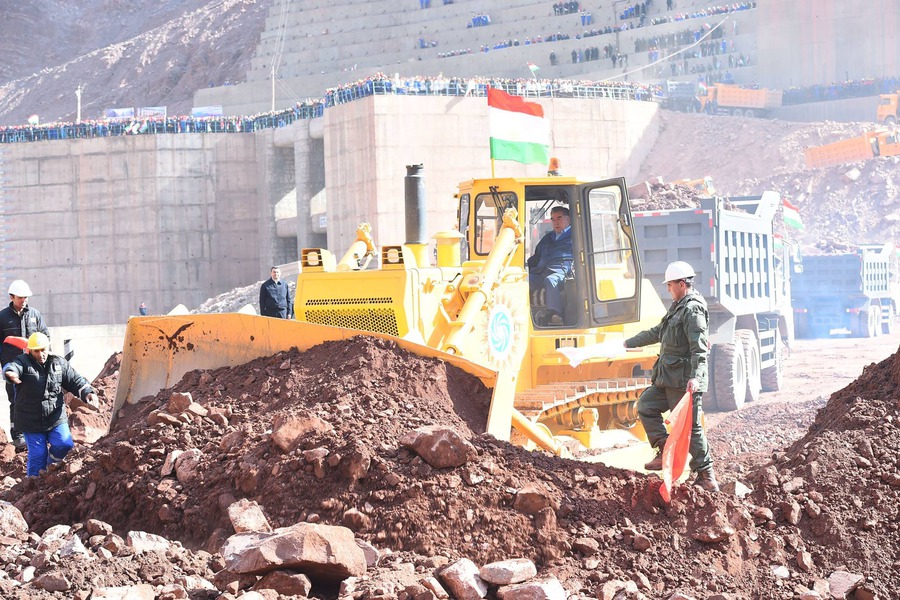
Two of the six turbines have already started producing energy for sale to raise funding to complete it. The first turbine went into service in November 2018 and the second one was introduced into operation in September 2019.
According to data from the Ministry of Finance of Tajikistan (MoF), 37.7 billion somonis have been spent for construction of this hydropower plant since 2008.
If built as planned, the Roghun hydropower plant is expected to end chronic power shortages in Tajikistan and allow it to export electricity to neighboring countries.