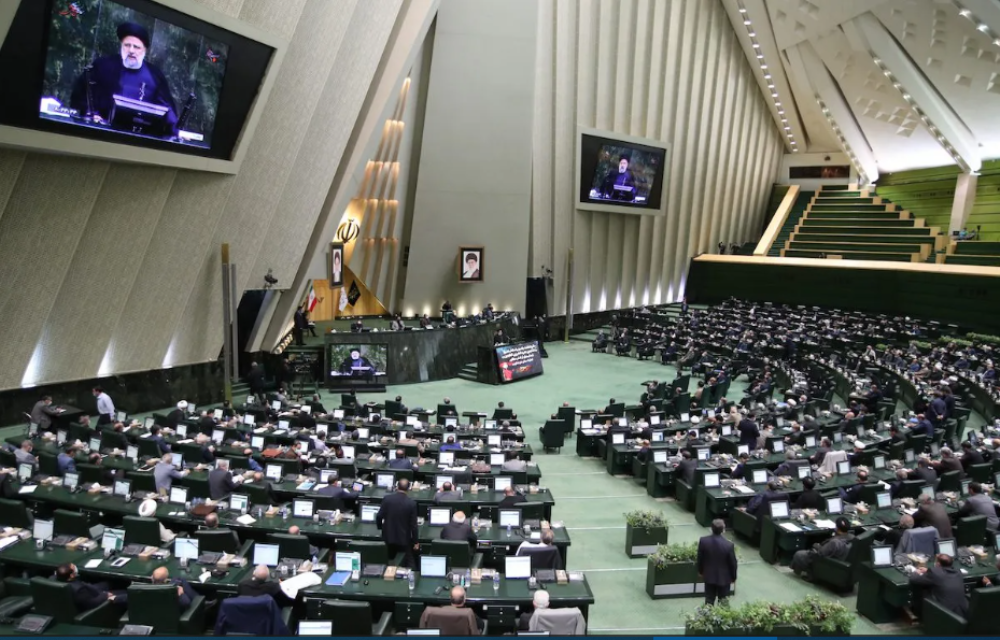
On Sunday, November 27, the Iranian parliament approved a bill for Iran's membership to the Shanghai Cooperation Organization (SCO), Iranian semi-official Mehr news agency reported.
The bill was reportedly approved by the overwhelming majority of the lawmakers. With 205 votes in favor, three votes against, and four abstentions, the Iranian Parliament has given the go-ahead to the bill for Iran to join the organization,
Abolfazl Amouei, the spokesman for the National Security and Foreign Policy Commission of parliament, said that the parliament's approval of Iran's membership to the SCO contains an international message of “Iran's multilateralism tendency in the field of foreign policy.”
Iranian Foreign Minister Hossein Amir-Abdollahian reportedly welcomed the parliament's move on Twitter, saying that "the categorical vote for the bill on the accession of the Islamic Republic of Iran to the SCO is indicative of our country's resolve and seriousness to develop regional, international and economic cooperation and bolster (the country's) approach to Asia."
"The approach of multilateralism is the reality of this century," he said.
Iran signed a memorandum of commitment to join the organization at the SCO summit that was held in the Uzbek city of Samarkand on September 15 and 16.
The process for the admission of Belarus as a full member of the body also began in Samarkand in September this year.
Recall, the Islamic Republic of Iran came one step closer to becoming a full member of the Shanghai Cooperation Organization at the 21st summit of the SCO leaders in the Tajik capital of Dushanbe on September 17 last year with the approval of its bid, 15 years after it first applied. On September 17, 2021, the SCO launched the procedures of Iran's accession to the SCO, which are expected to take "a fair amount of time".
The Shanghai Cooperation Organization was founded at a Summit in Shanghai in 2001 by the presidents of Russia, China, Kyrgyzstan, Kazakhstan, Tajikistan and Uzbekistan. It was preceded by the Shanghai Five mechanism.
The Shanghai Cooperation Organization currently has eight full members — China, Kyrgyzstan, Pakistan, Russia, Tajikistan, India, Kazakhstan and Uzbekistan.
Acceding members are Iran and Belarus.
Afghanistan (Afghanistan received observer status at the 2012 SCO summit in Beijing, China on 7 June 2012, but no country has yet provided diplomatic recognition to the Taliban, and its representatives have not participated in SCO meetings so far) Belarus (Belarus has been an observer state since 215), Iran (Iran has been an observer state since 2005) and Mongolia are observer states.
SCO’s dialogue partners include Armenia, Azerbaijan, Cambodia, Nepal, Sri Lanka and Turkey. ACEAN, CIS, Turkmenistan and the United Nations are guest attendances.
Initially focused on regional security, including border conflicts, terrorism and militant Islam, its activities have expanded to cover economics and trade, transport and law enforcement. Security and economic cooperation remain priorities. China and Russia are the dominant members. Russia regards Central Asia as its sphere of influence but Chinese economic sway is growing. At an informal level, the SCO is a diplomatic platform that helps address and contain potential friction.