Tajikistan ranks 114th among 146 nations in terms of gender equality

The Global Gender Gap Index notes this year, Tajikistan with 0.663 score ranks 114th among 146 nations in terms of gender equality.  The analysis presented in the Global Gender Gap Report 2022 is based on a methodology integrating the latest statistics from international organizations and a survey of executives. The Global Gender Gap Index benchmarks […]

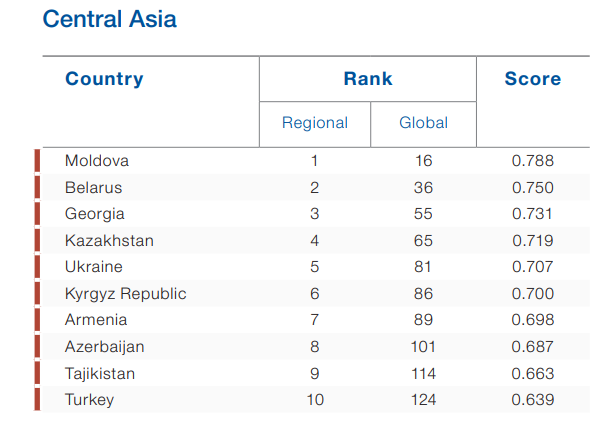
The Global Gender Gap Index notes this year, Tajikistan with 0.663 score ranks 114th among 146 nations in terms of gender equality. 

The analysis presented in the Global Gender Gap Report 2022 is based on a methodology integrating the latest statistics from international organizations and a survey of executives.

The Global Gender Gap Index benchmarks the current state and evolution of gender parity across four key dimensions: 1) economic participation and opportunity; 2) educational attainment; 3) health and survival; and 4) political empowerment.

In terms of economic participation and opportunity, Tajikistan is in the 107th place; education attainment – in the 117th place; health and survival – in the 84th place; and political empowerment – in the 109th place.    

As far as other Central Asia’s nations are concerned, the Global Gender Gap Index ranks Kazakhstan 65th and Kyrgyzstan 86th, respectively.     

The Global Gender Gap Report 2022 does not provide information about Turkmenistan and Uzbekistan.  

This year, the Global Gender Gap Index benchmarks 146 countries, providing a basis for robust cross-country analysis.  Of these, a subset of 102 countries have been represented in every edition of the index since 2006

Across the 146 countries covered by the 2022 index, the health and survival gender gap has reportedly closed by 95.8%, educational attainment by 94.4%, economic participation and opportunity by 60.3% and political empowerment by 22%.

In Central Asia, overall progress in closing the gender gap is unchanged from the last edition, at 69.1%.  At this pace, it would take 152 years to close the regional gender gap, according to the report.  In 2022, Central Asia reports the fourth-highest regional score out of the eight regions, just after North America, Europe, and Latin America and the Caribbean.

The report says that in Central Asia, Moldova (78.8%), Belarus (75%) and Georgia (73.1%) are the three top-ranked countries in this region, while Azerbaijan (68.7%), Tajikistan (66.3%) and Turkey (63.9%) rank at the bottom.

Join us on social media!

Article translations:

Related Article

Оби зулол
Tenisi
Оби зулол

Most Read

Коммерсбонк Точикистон

Recent Articles

RZD announces the restoration of passenger services between Moscow and Dushanbe

Direct rail services between the capitals of Russia and Tajikistan were suspended in March 2020 due to the COVID-19 pandemic.

#AP30/Stories. “Selam! Heller nichek?” How Tatars live today in Sughd province

On the 30th anniversary of "Asia-Plus," we continue to publish reports that remain relevant even after years. This story was told in 2021, and since then, little has changed in the life of the Tatar community in Tajikistan.

15,000 cameras, drones, and robots: how technology monitors pilgrims in Mecca and Medina

During Hajj 2026, Mecca and Medina were under unprecedented digital control.

Another child in Dushanbe removed from family and sent to boarding school

The Ministry of Internal Affairs reports that the parents did not pay adequate attention to the child.

Emomali Rahmon instructs to address issues in seed production following criticism of the industry

Issues have been noted with certification, seed quality, and the material and technical base of the industry.

Water, climate, and a $130 billion deficit: seven key outcomes of the Water Conference in Dushanbe

At the forum, countries and international organizations discussed new mechanisms for cooperation, investments, and technologies that are essential for addressing the global water crisis.

Eskhata Bank introduces a new generation children’s wallet

"Eshkata Bank" has created a full-fledged digital platform that helps children aged 7 to 16 learn how to manage money.