Atomic scientists set the "Doomsday Clock" closer to midnight than ever before on January 24, saying threats of nuclear war, disease, and climate volatility have been exacerbated by Russia's invasion of Ukraine, putting humanity at greater risk of annihilation.
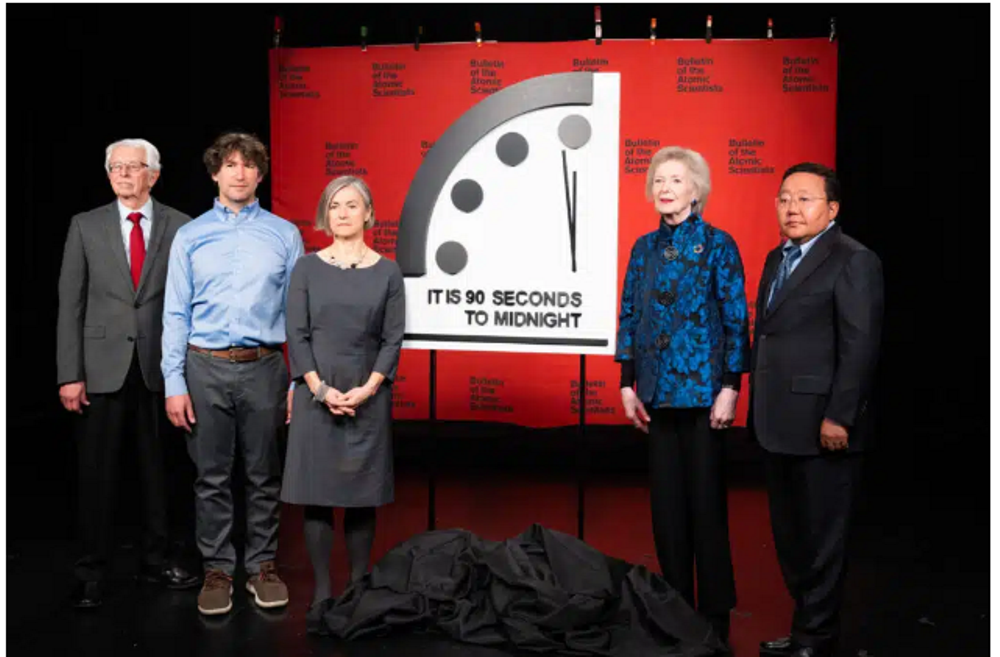
The "Doomsday Clock," created by the Bulletin of the Atomic Scientists to illustrate how close humanity has come to the end of the world, moved its "time" in 2023 to 90 seconds to midnight, 10 seconds closer than it has been for the past three years.
The Doomsday Clock’s time is set by the Bulletin of the Atomic Scientists’ Science and Security Board with the support of the Bulletin’s Board of Sponsors, which includes 10 Nobel Laureates. Previously, the Doomsday Clock had been set at 100 seconds to midnight since 2020.
The Bulletin of the Atomic Scientists’ official website notes that Mr. Rachel Bronson, PhD, president and CEO, Bulletin of the Atomic Scientists, said: “We are living in a time of unprecedented danger, and the Doomsday Clock time reflects that reality. 90 seconds to midnight is the closest the Clock has ever been set to midnight, and it’s a decision our experts do not take lightly. The US government, its NATO allies and Ukraine have a multitude of channels for dialogue; we urge leaders to explore all of them to their fullest ability to turn back the Clock.”
“Russia’s war on Ukraine has raised profound questions about how states interact, eroding norms of international conduct that underpin successful responses to a variety of global risks. And worst of all, Russia’s thinly veiled threats to use nuclear weapons remind the world that escalation of the conflict—by accident, intention, or miscalculation—is a terrible risk,” the Doomsday Clock statement says, noting that the possibility that the conflict could spin out of anyone’s control remains high.
The 2023 Doomsday Clock statement details other threats and threat multipliers beyond the most immediate risks related to the Russia-Ukraine War: nuclear weapons; climate crisis; bio-threats; and disinformation and disruptive technology.