Pakistan police arrest suspects over suicide bomb attack on a mosque in Peshawar

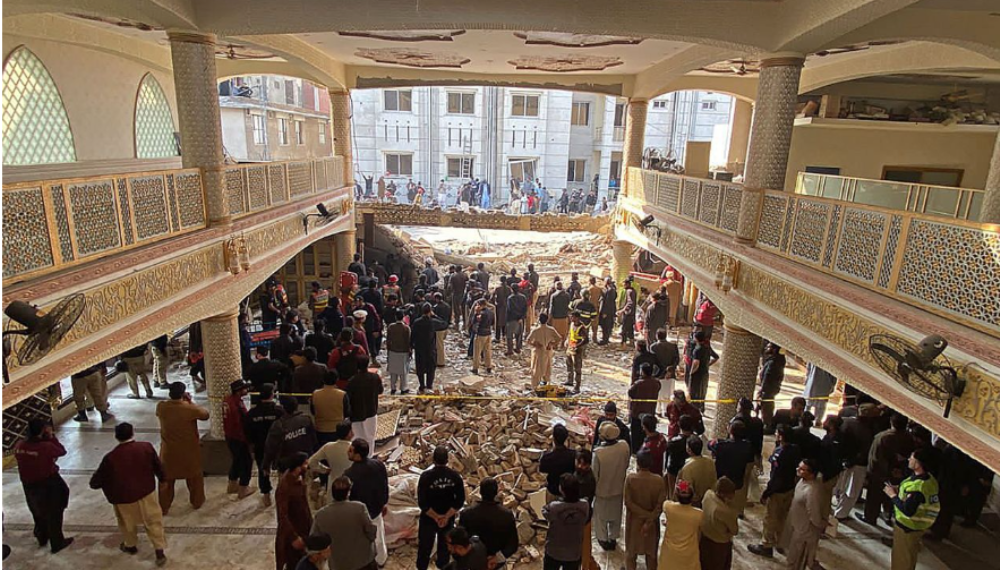
Pakistani authorities have made several arrests in connection with the bomb attack on a mosque in the northwestern city of Peshawar. Deutsche Welle says Peshawar Police Chief Ijaz Khan told Reuters that several suspects had been arrested and police were investigating the possibility that they had received “internal assistance” to get inside the highly fortified […]

Pakistani authorities have made several arrests in connection with the bomb attack on a mosque in the northwestern city of Peshawar.

Deutsche Welle says Peshawar Police Chief Ijaz Khan told Reuters that several suspects had been arrested and police were investigating the possibility that they had received “internal assistance” to get inside the highly fortified compound where the mosque was located.

A senior official separately told AFP, on condition of anonymity, that police had detained 23 people in connection with the attack.  The official also confirmed that they were investigating possible help from the inside, adding that they were looking into possible connections with groups outside of Pakistan.

Mass media reports say at least 101 people, including 27 police official, were killed and 217 others injured on January 30 as a suicide bomber blew himself up inside a crowded mosque in Peshawar.

The attacker reportedly appeared to have passed through several barricades manned by security forces to get into the “Red Zone” compound that houses police and counter-terrorism offices in the northwestern city of Peshawar.

CNN reports that police suspect that 12 kilograms of explosives were used by a suicide bomber.  

The Associated Press (AP), citing the provincial police chief, reported on February 2 that the suicide bomber disguised himself in police uniform and did not raise suspicion among the guards. 

Police have reportedly identified the bomber are reportedly close to arresting suspects who helped him carry out the bombing, one of the deadliest ever in Peshawar.

According to AP, Pakistan’s defense and interior ministers in speeches to Parliament this week blamed the Pakistani Taliban, who maintain sanctuaries in neighboring Afghanistan, for orchestrating the bombing.

The Pakistani Taliban, known as Tehreek-e-Taliban (TTP), are a separate group but allied with the Afghan Taliban.

Peshawar is the capital of Khyber-Pakhtunkhwa province that borders Afghanistan and the site of frequent attacks by Tehreek-e Taliban.


Join us on social media!

Article translations:

Related Article

Оби зулол
Оби зулол
Tenisi

Most Read

Коммерсбонк Точикистон

Recent Articles

RZD announces the restoration of passenger services between Moscow and Dushanbe

Direct rail services between the capitals of Russia and Tajikistan were suspended in March 2020 due to the COVID-19 pandemic.

#AP30/Stories. “Selam! Heller nichek?” How Tatars live today in Sughd province

On the 30th anniversary of "Asia-Plus," we continue to publish reports that remain relevant even after years. This story was told in 2021, and since then, little has changed in the life of the Tatar community in Tajikistan.

15,000 cameras, drones, and robots: how technology monitors pilgrims in Mecca and Medina

During Hajj 2026, Mecca and Medina were under unprecedented digital control.

Another child in Dushanbe removed from family and sent to boarding school

The Ministry of Internal Affairs reports that the parents did not pay adequate attention to the child.

Emomali Rahmon instructs to address issues in seed production following criticism of the industry

Issues have been noted with certification, seed quality, and the material and technical base of the industry.

Water, climate, and a $130 billion deficit: seven key outcomes of the Water Conference in Dushanbe

At the forum, countries and international organizations discussed new mechanisms for cooperation, investments, and technologies that are essential for addressing the global water crisis.

Eskhata Bank introduces a new generation children’s wallet

"Eshkata Bank" has created a full-fledged digital platform that helps children aged 7 to 16 learn how to manage money.