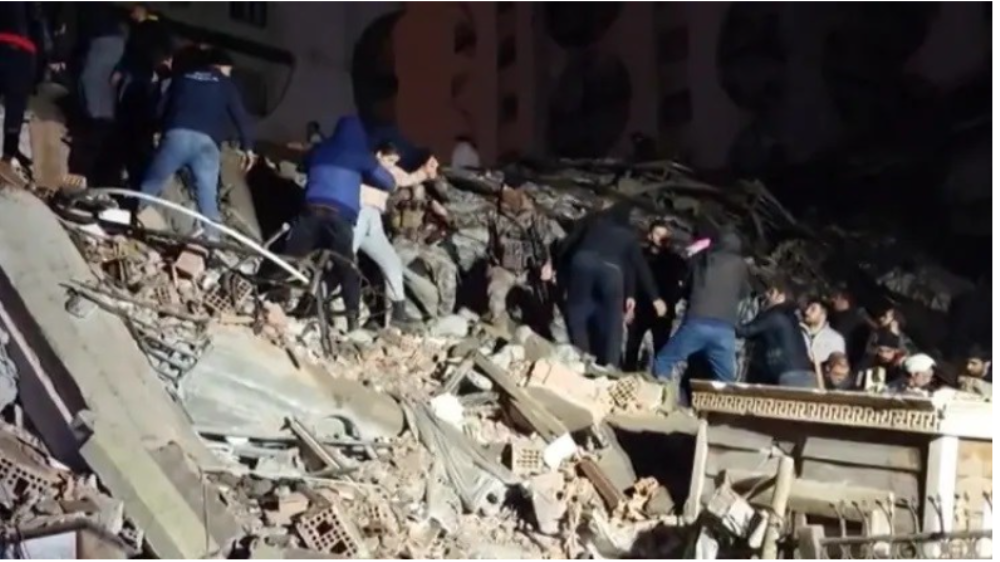
Media reports say the major 7.8-magnitude earthquake that struck Turkiye and Syria early Monday morning killed more than 3,000 people and flattened thousands of buildings as rescuers dug with bare hands for survivors.
Multi-story apartment buildings full of residents reportedly were among the 5,606 structures reduced to rubble in Turkiye, while Syria announced dozens of collapses, as well as damage to archaeological sites in Aleppo.
An Arab Independent Media Satellite Channel Al Madeen reports that the head of Syria's National Earthquake Center, Raed Ahmad, called it "the biggest earthquake recorded in the history of the center."
The initial quake was followed by dozens of aftershocks, including a 7.5-magnitude tremor that shook the region.
According to Al Madeen, the government and rescuers said that at least 1,293 people died across Syria,.
Turkish government officials reported another 1,762 deaths, putting the combined total at 3,055. Ankara declared seven days of mourning for the dead.
Meanwhile, The New York Times reports that earthquake’s death toll has jumped to over 4,300 in Turkiye and Syria.
A powerful earthquake and aftershocks collapsed thousands of buildings, killed more than 4,300 people and raised the specter of a new humanitarian disaster in an area of the world already racked by war, a refugee crisis and deep economic troubles, The New York Times reported today.
The rescue was being hampered by a winter blizzard that covered major roads in ice and snow. Officials said the earthquake made three major airports in the area inoperable, further complicating deliveries of vital aid.
Meanwhile, the World Health Organization (WHO) has warned that the death toll from Monday’s strong earthquake in south-eastern Turkey, near Syria's border, could rise eight-fold as rescuers find more victims in the rubble.
"We always see the same thing with earthquakes, unfortunately, which is that the initial reports of the numbers of people who have died or who have been injured will increase quite significantly in the week that follows," the WHO's senior emergency officer for Europe, Catherine Smallwood, told AFP.
Ms. Smallwood added that the snowy conditions will leave many people without shelter, adding to the dangers.
The BBC says the toll, which currently stands at more than 3,400 people, has increased rapidly.
International leaders have offered Turkiye and Syria condolences over losses in earthquake
The US Geological Survey said the 7.8 magnitude tremor struck at 04:17 local time (01:17 GMT) at a depth of 17.9km (11 miles) near the city of Gaziantep.
Seismologists said the first quake was one of the largest ever recorded in Turkey. Survivors said it took two minutes for the shaking to stop.
The second quake – triggered by the first – had a magnitude of 7.5, and its epicenter was in the Elbistan district of Kahramanmaras province.
Many aftershocks are still being felt across the region.