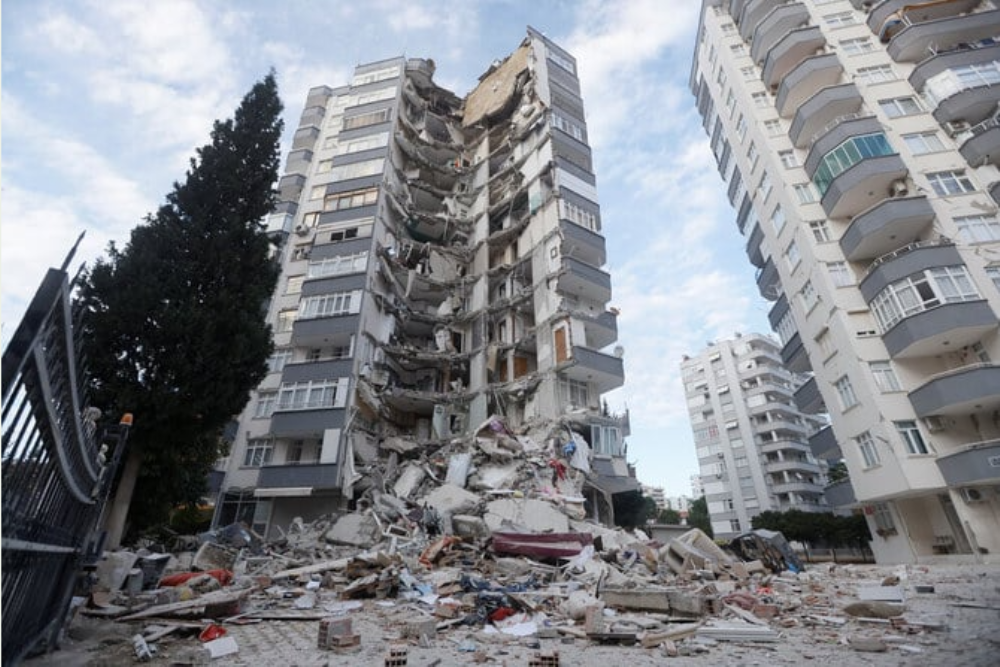
The death toll is continuing to rise in Turkiye and Syria. Mass media reports that cold, hunger and despair gripped hundreds of thousands of people left homeless after the earthquakes that struck Turkiye and Syria three days ago as the death toll passed 20,000 on Thursday.
The Indian Express reports that rescuers pushed to find survivors on Friday as the death toll in the massive earthquake that struck regions in Turkiye and Syria crossed 20,700. Tens of thousands are injured or displaced.
Meanwhile, The Guardian and The Wall Street Journal (WSJ) say the death toll from Turkiye-Syria earthquakes passed 21,000 on February 9. Death toll in Turkiye alone is now more than 17,000 following Monday’s earthquake.
Agency France Presse (AFP) reports that officials and medics said 17,674 people had died in Turkey and 3,377 in Syria from Monday’s 7.8-magnitude tremor, bringing the confirmed total to 21,051.
It reportedly comes after the White Helmets said on Twitter, that at least 2,030 people have been killed with more than 2,950 injured.
Countries around the world have mobilized rapidly to send aid and rescue workers to Turkiye. The Turkish government will distribute 10,000 Turkish lira (equivalent to 532 U.S. dollars) to affected families.
In a statement released on February 9, the World Bank announced US$1.78 billion in assistance to help “relief and recovery efforts following devastating earthquakes and aftershocks in Turkiye that have already resulted in massive loss of life, injuries, and very significant damages in and around southeastern Turkiye.” The World Bank said that US$780 million will become available for Ankara immediately, as the funds will be diverted from two existing World Bank loan projects in Turkiye. Another $1 billion in assistance for Turkiye's recovery and reconstruction is also being prepared but will take more time to arrange.
Meanwhile, the UN yesterday insisted on the need to avoid "politicization" of aid to earthquake victims in Syria, which faces international sanctions, and urged Washington and Brussels to ensure there were "no impediments."
“Emergency response must not be politicized,” Geir Pedersen, the UN Special Envoy for Syria, told reporters in Geneva, saying aid needed to get to areas controlled by Damascus as well as those held by rebels.
The first United Nations convoy carrying emergency aid to a rebel-held area of Syria reportedly crossed from Turkiye on Thursday.
Arab News says the Syrian government wants all international aid to pass through Damascus, using a system known as “cross-line operations.” This means that relief supplies are delivered to authorities in the capital, who then distribute it where it is needed, including to rebel-held parts of the country.
The alternative, which the Syrian government is reportedly opposed to, is “cross-border” aid that bypasses Damascus and is shipped directly to the affected areas by other nations.