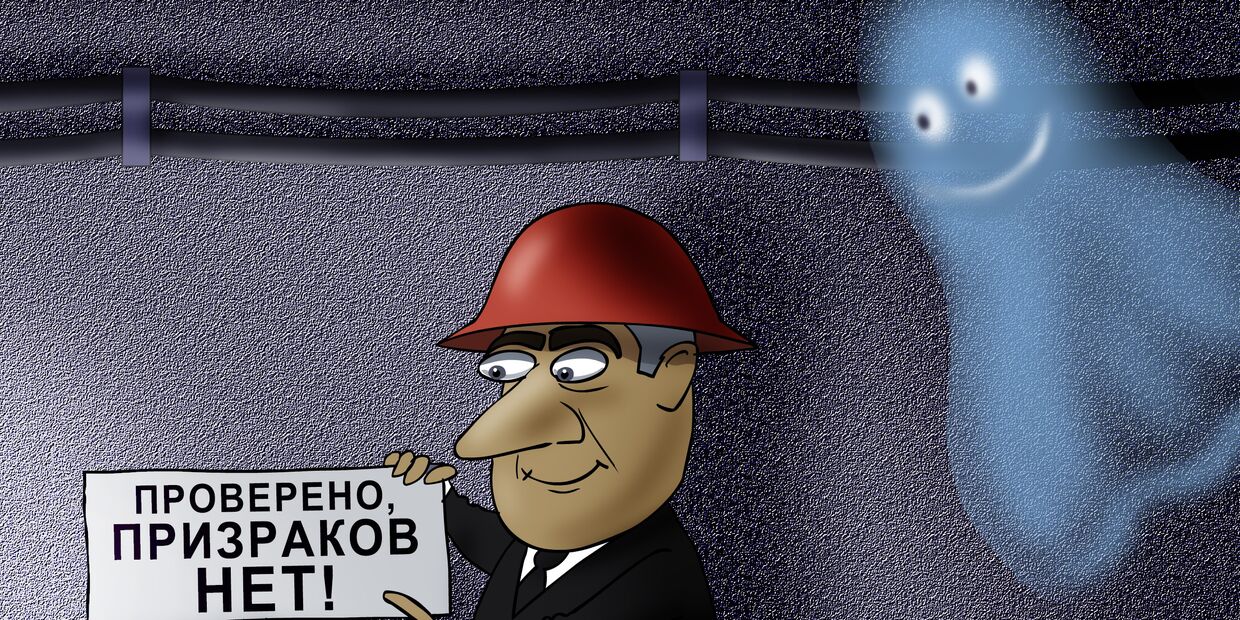
The Open Joint-Stock Company (OJSC) Power Distribution Networks has found “dead souls” (non-existent electricity consumers) in the country’s power system. The company notes that “dead souls” create difficulties for proper operation of the billing system.
“In previous years it was considered that electricity in large quantities was consumed by residential customers that does not correspond to reality,” OJSC Power Distribution Networks says, citing the billing program analysis.
In order to reduce the rate of electricity losses non-existent consumers were introduced to program that still creates difficulties for its proper functioning
According to OJSC Power Distribution Networks, total electricity arrears have amounted to about 3.7 billion somonis (equivalent to about 340 million US dollars); residential customers reportedly account for 40 percent (about 1.5 billion somonis) of total electricity arrears.
Each time such statistics are published, the population of the country has rightly been indignant. People have wondered why such huge debts accumulate if residential customers are disconnected from the power grid for late payment of electricity.
Barqi Tojik had previously claimed that the bulk of the population’s electricity arrears had been formed in the 1990s.
However, such claims are refuted by the statistics provided by Barqi Tojik: residential customers’ electricity arrears increased 1 billion somonis in early 2019 to 1.5 billion somonis in early 2023.
In a report released at a news conference in Dushanbe, an official from OJSC Power Distribution Networks noted on February 13 that some enterprises “systematically do not pay for electricity on time and in full.”
Thus, the Tajik Aluminum Company (TALCO) now owes 487 million somonis for electricity. Among incorrigible nonpayers are also residential customers – 1.5 billion somonis, the Agency for Land Reclamation and Irrigation under the Government of Tajikistan – 460 million somonis, the federally funded institutions – 96 million somonis; the State Unitary Enterprise (SUE) Ob-u Korez (waterworks) – 76 million somonis, and the Joint Venture Tojikkimiyocanoat – 37 million somonis.
Recall, OJSCs Power Distribution Networks and Power Transmission Networks were established on the basis of the national power utility company (Barqi Tojik) in summer 2020
The process of restructuring of Barqi Tojik began in 2012 and Barqi Tojik was expected to be divided into three independent companies in late 2018: (i) generation; (ii) transmission business; and (iii) distribution.
Barqi Tojik now operates just as power generation company.
The main objective of the restructuring of Barqi Tojik is in ensuring transparency in the country’s energy system.